
Opensource AI: A Practical Guide to Models and Licenses
On this page
Opensource AI: A Practical Guide to Models and Licenses
Short answer: Opensource AI is not simply an AI model that you can download. A genuinely open system should give people meaningful freedom to use, study, modify, and share it. That requires more than visible weights. The relevant code, data information, parameters, and legal terms must make meaningful modification possible.
The phrase opensource ai is often used as a broad label for downloadable models, open weights, public research, and permissive software. Those ideas overlap, but they are not identical. This guide explains the difference, shows what to inspect in a model release, and offers a practical workflow for choosing an AI system without confusing access with openness. Sources and model terms were checked on November 5, 2026.
What does open source AI actually mean?
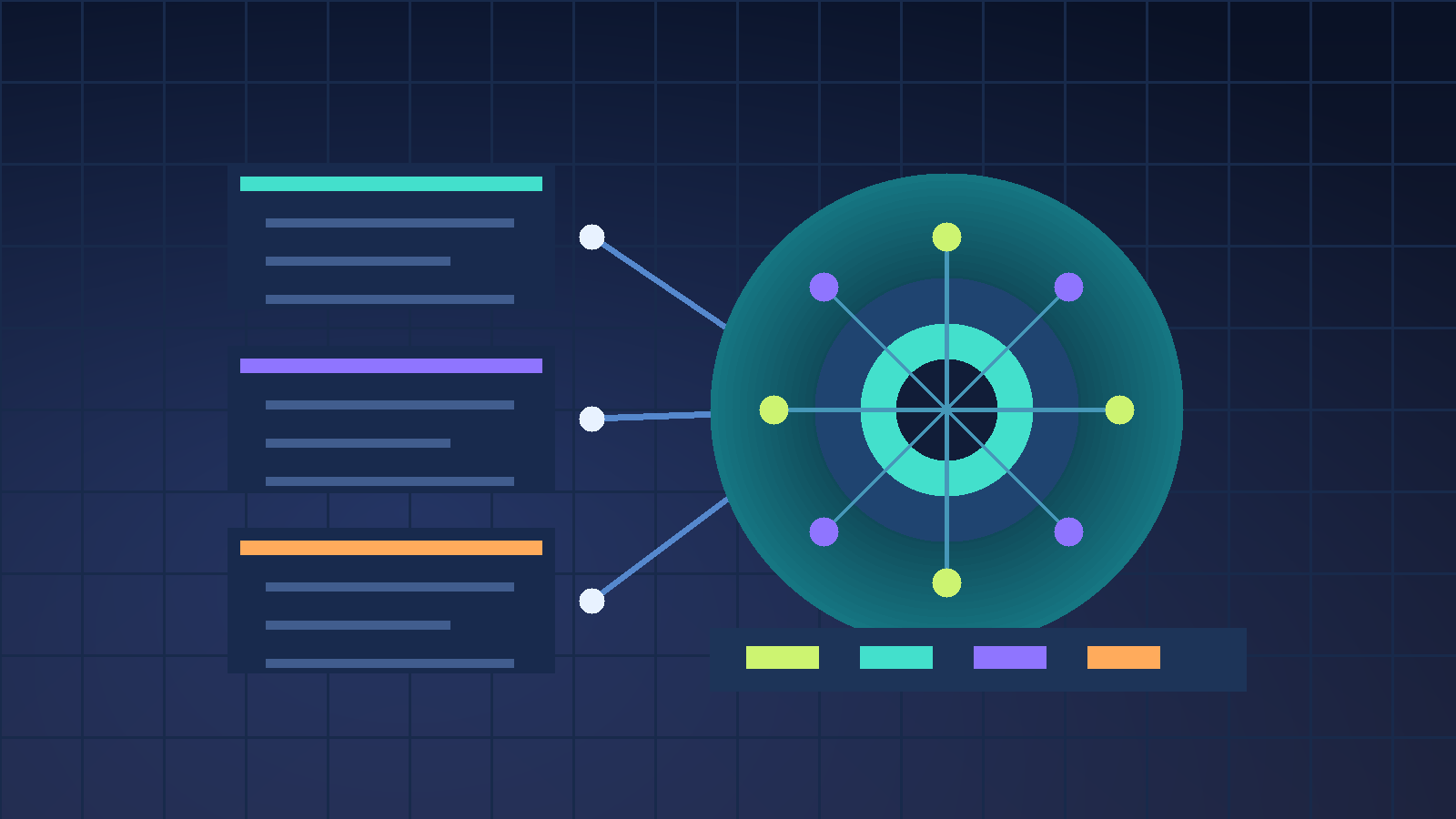
The Open Source AI Definition 1.0 from the Open Source Initiative describes an Open Source AI system through four freedoms: people must be able to use it for any purpose, study how it works, modify it, and share it with or without changes. The point is not a marketing label. It is whether the system gives users practical autonomy.
That definition matters because machine learning systems are assembled from parts that traditional software licenses do not fully describe. An AI system can include training information, filtering steps, architecture, parameters, inference code, evaluation code, and documentation. If a user receives only a compiled service or a set of weights, the user may not have the preferred form needed to understand or change the system.
The OSI definition therefore asks a deeper question: what would another skilled team need in order to build a substantially equivalent system or make a meaningful fork? The answer includes data information, complete source code used to train and run the system, and model parameters. Each part also needs terms that permit the relevant use.
This is the useful distinction between open source AI as a definition and a casual claim that a model is “open.” A project can be generous, transparent, or easy to download without meeting every requirement of the definition. That does not make the project worthless. It means the description should be precise.
Is open weights the same as open source AI?
No. Open weights means that the learned parameters are available to download or use under stated terms. Open source AI is broader because it asks whether people can study and modify the system using the information and code needed to understand how those parameters were derived. The OSI FAQ explains why weights alone do not answer that question.
Weights can still be valuable. They may allow local inference, fine-tuning, experimentation, lower latency, or more control over sensitive inputs. A team can learn a great deal from a model card, an architecture description, and a downloadable checkpoint. However, those benefits should not be inflated into a claim that the whole training system is open.
This distinction also changes how you compare AI open source tools. A hosted interface, a repository, a model checkpoint, and a training dataset are different artifacts. Ask which one is actually available. Then ask what the license permits you to do with it. A repository might contain inference code while the weights carry separate terms. A model card might disclose a dataset name without providing the data or the processing code.
The safest wording is often specific: “open weights,” “source-available,” “downloadable checkpoint,” “permissively licensed code,” or “an Open Source AI system under the OSI definition.” Each phrase tells a reader something different.
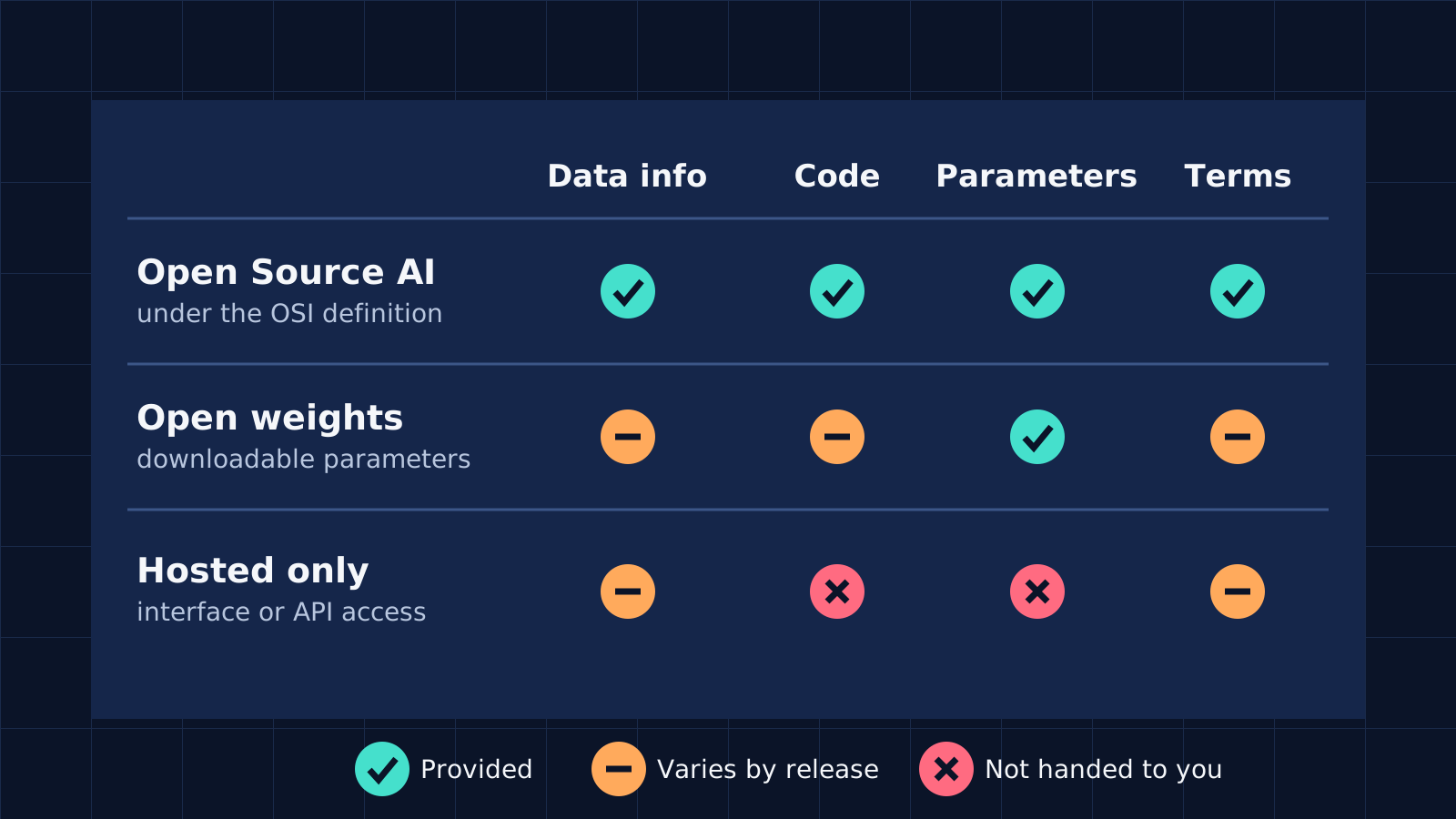
This table compares the labels you will meet most often and what each one leaves you to check.
| Label | What you receive | What you still need to check |
|---|---|---|
| Open Source AI under the OSI definition | Data information, code, and parameters, with terms that grant the four freedoms | Whether the exact release really provides each component |
| Open weights | Learned parameters under stated terms | Training code, data information, and any use restrictions |
| Source-available or custom license | Code or weights under project-specific terms | Commercial limits, redistribution rules, and required notices |
| Hosted only | Access through an interface or API | Provider terms, data retention, pricing, and update control |
Which components should you inspect?
The Open Source AI Definition identifies three practical groups that should be available in the preferred form for modification: data information, code, and parameters. Inspecting all three is more informative than checking whether a download button exists.
Data information
Data information is not necessarily a promise that every training file can be redistributed. The OSI definition asks for enough detail to understand the data used, its provenance, scope, characteristics, selection, labeling, processing, and filtering. It also asks for listings of public or third-party data and information about where those materials can be obtained.
That approach recognises a real constraint. Medical, personal, licensed, or Indigenous knowledge may not be shareable even when it was legally used for training. The OSI FAQ explains that data information can help downstream builders understand the system without pretending that every sensitive record can be republished.
Code
Code should cover the parts that determine how the system was produced and operated. Depending on the project, that can include data processing, filtering, training settings, validation, testing, tokenization, architecture, inference, and supporting libraries. A polished inference repository is useful, but it may not be the complete code needed to study or reproduce the training process.
For a practical audit, record the exact repository, commit or release, model card, and license file. The Hugging Face license documentation is a useful reminder that license metadata belongs to the specific repository. Do not copy a license assumption from a related model or from the organisation’s homepage.
Parameters
Parameters include learned weights and other configuration settings. Some projects publish only final weights. Others publish intermediate checkpoints, optimizer state, conversion files, quantized variants, or multiple releases. These differences affect what can be studied, fine-tuned, or reproduced.
A model card should tell you which files are included, how they relate to the architecture, and what hardware or software is needed. It should also state the intended use, limitations, languages, evaluation methods, and license. A large parameter count is not proof of openness or usefulness.
How do licenses change what you can do?
A license turns a technical download into a set of permissions and obligations. Read the license for the exact model version before you build a product, redistribute weights, offer a hosted service, or combine the model with other data. The permissive phrase “free to use” is not a substitute for the legal text.
Mistral’s official licensing help page says that most of its open models use Apache 2.0, while certain models use a modified MIT license. It also directs users to the model cards for the terms that apply to each model. That is a good operational habit: check the model card, not just the family name.
Google’s Gemma Terms of Use allow use, reproduction, modification, and distribution subject to conditions. The terms also define distribution broadly, include use restrictions, and require notices for distributed copies or derivatives. A developer can find the terms workable while still needing to comply with them. “Open source AI Google” searches should lead to the exact current terms, not a generic assumption about every Google model.
Meta’s Llama 3.1 Community License Agreement grants a limited, royalty-free license. It requires a copy of the agreement and a visible “Built with Llama” notice on redistribution, incorporates an Acceptable Use Policy, and sends licensees with more than 700 million monthly active users on the release date to Meta for a separate license. That means Llama may be broadly accessible and useful for development, but the name alone does not establish compliance with the OSI Open Source AI Definition.
Here is how those three official sources compare. Terms change between releases, so treat each row as a starting point for the exact model you plan to use.
| Model family | Official terms | Conditions to note |
|---|---|---|
| Mistral open models | Most under Apache 2.0, certain models under a modified MIT license | Under the modified MIT license, companies with monthly revenue above $20M need a commercial license or Mistral Studio |
| Gemma | Gemma Terms of Use | Use restrictions apply, and recipients must get a copy of the agreement and notice of those restrictions |
| Llama 3.1 | Llama 3.1 Community License Agreement | Acceptable Use Policy, “Built with Llama” notice, and the 700 million monthly active user clause |
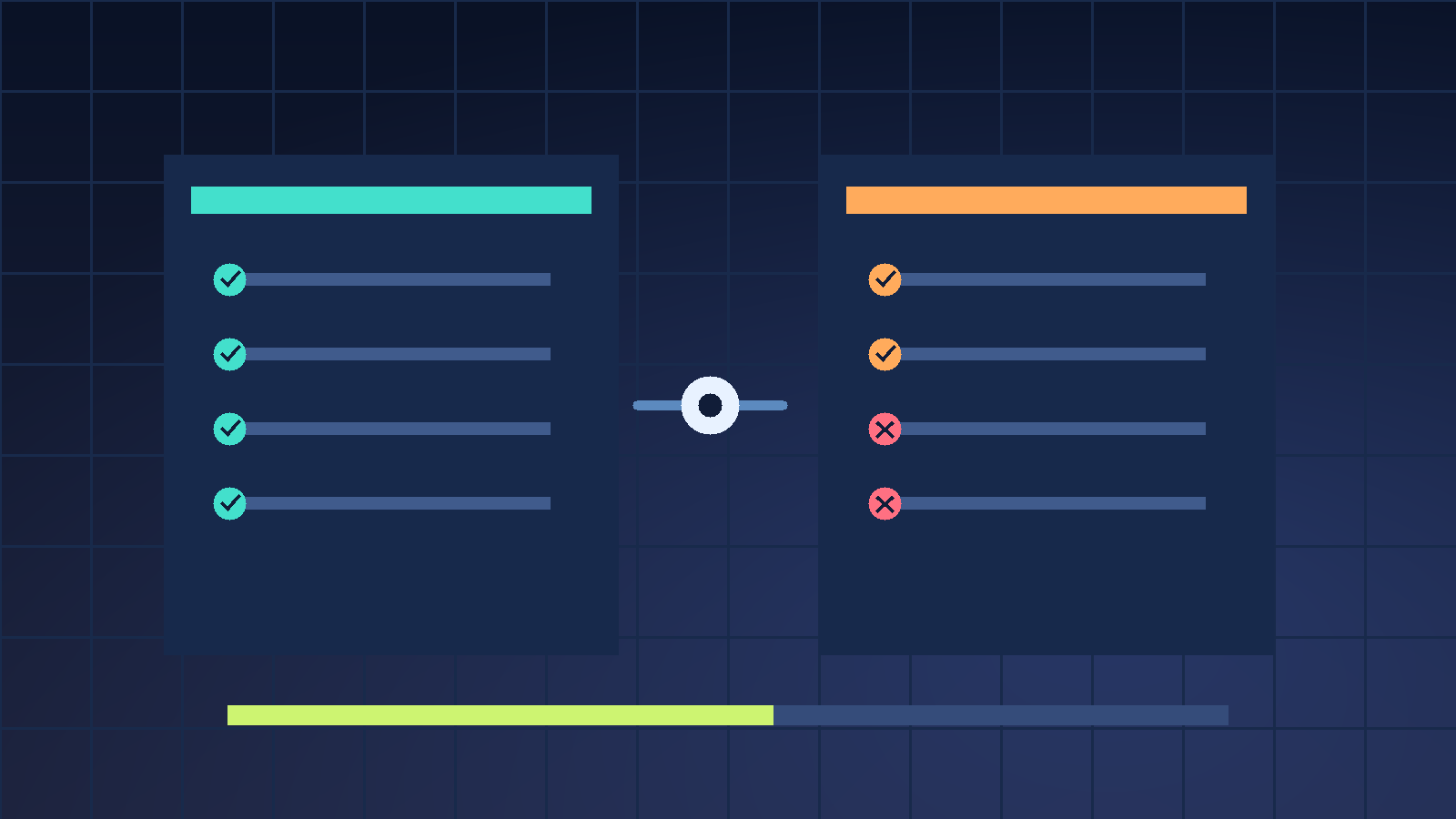
A basic license review should answer these questions:
- Can you use the model commercially?
- Can you modify and fine-tune it?
- Can you redistribute the weights or derivatives?
- Must you include notices, attribution, or an acceptable-use policy?
- Are there conditions for hosted inference or a model-as-a-service product?
- Do the license and data terms cover the inputs and outputs in your workflow?
If any answer is unclear, keep the model in a research or evaluation lane until the terms are reviewed. This is not legal advice. It is a way to avoid treating an unfamiliar model license as if it were MIT or Apache 2.0.
Which open source AI models should you evaluate?
Start with the task, not a popularity list. The OSI FAQ gives examples of systems it checked during its validation work, including Pythia, OLMo, Amber, CrystalCoder, and T5. It also says those results were part of the definitional process and were not certifications of individual projects.
| Result in the OSI FAQ | Systems named |
|---|---|
| Passed the validation phase | Pythia, OLMo, Amber, CrystalCoder, T5 |
| Would probably pass if licenses or legal terms changed | BLOOM, Starcoder2, Falcon |
| Did not pass (missing components or incompatible legal terms) | Llama2, Grok, Phi-2, Mixtral |
That warning is useful. A model appearing on a list does not mean it will be the best option for your language, latency, hardware, or risk profile. A model can satisfy a freedom or documentation question and still fail your task. Conversely, a model that is not OSI-compliant may still be a practical open-weight option when its terms fit your use case.
Use a model leaderboard to understand what the site has measured, but keep benchmark context separate from license analysis. Look for the model release date, evaluation set, language coverage, hardware assumptions, quantization method, and whether the result is a stored test or a provider claim. A benchmark score without a test record is not enough to choose a production system.
For a first comparison, place candidate models into three buckets:
- Open source under a defined framework: the project provides the components and terms needed for meaningful study and modification.
- Open weights or source-available: useful artifacts are downloadable, but one or more components, permissions, or legal terms are narrower.
- Hosted only: the model may be capable, but you depend on the provider for access, updates, retention controls, and availability.
These buckets are not rankings. They describe operating responsibility. The right choice depends on whether your team can maintain local inference, handle licenses, protect data, and evaluate changes.
How should a team choose an AI open source tool?
A good selection process is small, dated, and reproducible. Choose one real task, collect a representative sample, and define what “good enough” means before looking at model outputs. Include difficult cases and failure cases. Record the model version, prompt, input constraints, output, reviewer notes, license, hardware, and known limitations.
Then compare the complete workflow. A local model may reduce network exposure and recurring inference fees, but it creates responsibility for hardware, patching, monitoring, abuse controls, and updates. A hosted model may be easier to start and easier to scale, but it can create dependency on an external service, a changing price, or a provider’s data policy.
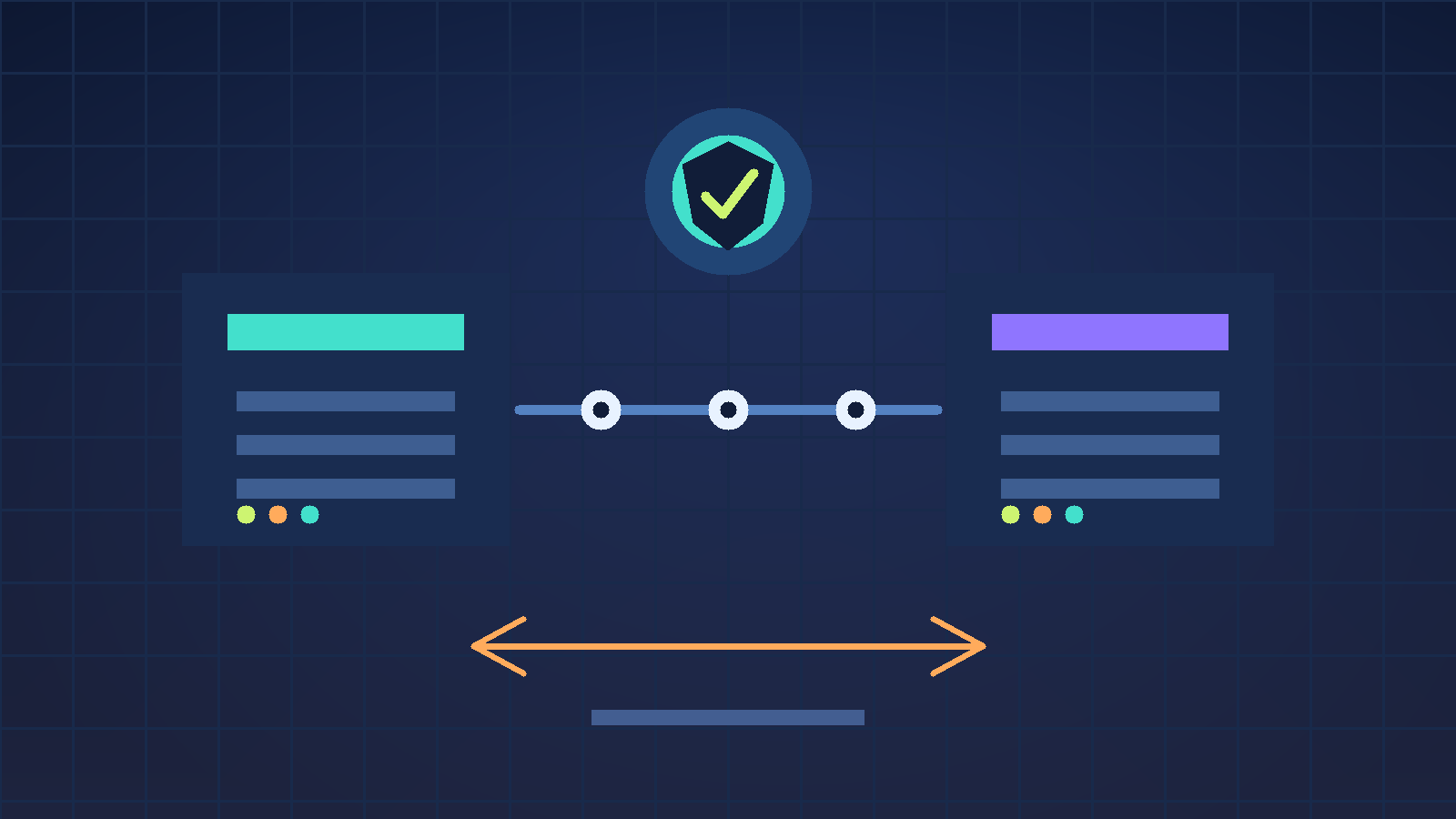
A reversible architecture is usually safer than a permanent early commitment. Keep the model boundary clear. Store evaluation records separately from user data. Make it possible to switch models or turn off an automated step. Limit permissions when the system can call tools. For a broader view of capability, cost, agents, and governance, see our future of AI guide.
Newly Stack’s AI tool directory is a discovery layer, not a substitute for reading official terms. Before adopting a tool, open its official pricing, documentation, privacy policy, model card, and license. If the site does not have a verified test or the provider does not publish a needed fact, treat that field as unknown rather than filling it with a guess.
What are the limits and risks of open source AI?
Openness does not guarantee safety, accuracy, support, or legal certainty. Publishing code and weights can make research easier, but it can also transfer more responsibility to the deployer. A local model can still leak sensitive data through logs, produce confident errors, or be misused by an application with weak access control.
Training information can be incomplete or difficult to verify. A model may have a permissive software license while the training data has separate copyright, privacy, or contractual concerns. A model card may explain intended use without proving that every downstream deployment is safe. These are reasons to keep provenance and evaluation in the same decision record.
The practical response is not to reject every open system. It is to make the operating boundary explicit. Define which tasks are allowed, what data may enter, which outputs need review, and how incidents are reported. Compare a model update against the previous version. Keep a rollback path. If a system cannot be monitored or stopped, it is not ready for a high-impact workflow.
A practical checklist before deployment
Use this short checklist when reviewing a new model or open source AI tool:
- Identity: Is the exact model name, release, repository, and checksum recorded?
- Permissions: Does the license permit your intended use, modification, redistribution, and hosting?
- Components: Are the data information, code, parameters, and documentation sufficient for your goal?
- Data: What inputs are allowed, where are logs stored, and who can access them?
- Quality: Which real tasks were tested, on what date, with which version and review method?
- Operations: Who handles updates, abuse reports, outages, and model regressions?
- Reversibility: Can you switch models, disable an agent action, or restore a previous version?
- Disclosure: Can users understand that an AI system is involved and challenge an important result?
The How We Test page provides useful context for separating a practical test from a marketing statement. The goal is not to create a perfect score. It is to create enough evidence for a responsible decision.
Frequently Asked Questions
What is opensource AI?
Opensource AI describes an AI system shared under terms and conditions that give people meaningful freedoms to use, study, modify, and share it. The Open Source AI Definition also points to the data information, code, and parameters needed to make meaningful modification possible.
Are open weights the same as open source AI?
No. Open weights make learned parameters available, but a system may still withhold the training information or code needed to study and modify how those parameters were produced. Read the exact license and model documentation before calling a model open source.
Is Llama open source?
Do not answer from the model name alone. Llama releases ship under Meta community licenses, such as the Llama 3.1 Community License Agreement, which incorporates an Acceptable Use Policy. The OSI FAQ lists Llama2 among the systems it analyzed that did not pass its validation phase. Read the license for the exact release before making an open source claim.
Is Gemma an open source AI model?
Gemma is distributed under Google terms that permit use, modification, and distribution subject to conditions and restrictions. That can be useful for development, but it is not a reason to assume that every Gemma release satisfies the Open Source AI Definition. Check the current terms for the exact model.
How should I choose an open source AI model?
Start with the task, then check the exact license, available components, language coverage, hardware needs, evaluation record, update process, and deployment responsibility. A downloadable model is only a fit when your team can operate it safely and legally for the intended workflow.
Which AI models passed the OSI validation?
The OSI FAQ names Pythia, OLMo, Amber, CrystalCoder, and T5 as the models that passed its validation phase. It also says these results were part of the definitional process and are not certifications of any kind, and that OSI will not validate or review individual AI systems.
Does open source AI require publishing all training data?
Not in every case. The Open Source AI Definition asks for sufficiently detailed data information, including a complete description of the data used for training. The OSI FAQ explains that data which cannot be shared for explainable reasons, such as personally identifiable information, needs a detailed description instead.
Does open source AI mean the model is safe?
No. The OSI FAQ says the definition does not specifically guide or enforce ethical, trustworthy, or responsible AI development practices. Openness describes the freedoms and components you receive. Your team still needs its own evaluation, access controls, review process, and a way to stop or roll back the system.
The short answer
Opensource AI is best understood as a set of freedoms supported by complete enough technical information and usable legal terms. Open weights are one part of that picture. They may be valuable without being the same as an Open Source AI system under the OSI definition.
For a sound decision, record the exact release, read its license, inspect the model card, check the available components, run a dated task evaluation, and define who owns deployment and review. That process is slower than copying a download link, but it gives a clearer answer about what the system can really do.
Frequently asked questions
What is opensource AI?
Opensource AI describes an AI system shared under terms and conditions that give people meaningful freedoms to use, study, modify, and share it. The Open Source AI Definition also points to the data information, code, and parameters needed to make meaningful modification possible.
Are open weights the same as open source AI?
No. Open weights make learned parameters available, but a system may still withhold the training information or code needed to study and modify how those parameters were produced. Read the exact license and model documentation before calling a model open source.
Is Llama open source?
Do not answer from the model name alone. Llama releases ship under Meta community licenses, such as the Llama 3.1 Community License Agreement, which incorporates an Acceptable Use Policy. The OSI FAQ lists Llama2 among the systems it analyzed that did not pass its validation phase. Read the license for the exact release before making an open source claim.
Is Gemma an open source AI model?
Gemma is distributed under Google terms that permit use, modification, and distribution subject to conditions and restrictions. That can be useful for development, but it is not a reason to assume that every Gemma release satisfies the Open Source AI Definition. Check the current terms for the exact model.
How should I choose an open source AI model?
Start with the task, then check the exact license, available components, language coverage, hardware needs, evaluation record, update process, and deployment responsibility. A downloadable model is only a fit when your team can operate it safely and legally for the intended workflow.
Which AI models passed the OSI validation?
The OSI FAQ names Pythia, OLMo, Amber, CrystalCoder, and T5 as the models that passed its validation phase. It also says these results were part of the definitional process and are not certifications of any kind, and that OSI will not validate or review individual AI systems.
Does open source AI require publishing all training data?
Not in every case. The Open Source AI Definition asks for sufficiently detailed data information, including a complete description of the data used for training. The OSI FAQ explains that data which cannot be shared for explainable reasons, such as personally identifiable information, needs a detailed description instead.
Does open source AI mean the model is safe?
No. The OSI FAQ says the definition does not specifically guide or enforce ethical, trustworthy, or responsible AI development practices. Openness describes the freedoms and components you receive. Your team still needs its own evaluation, access controls, review process, and a way to stop or roll back the system.
Sources
Pages we read for this article, with the date we accessed each one.
- The Open Source AI Definition 1.0, Open Source Initiativeaccessed November 5, 2026
- Open Source AI Definition FAQs, Open Source Initiativeaccessed November 5, 2026
- Licenses, Hugging Face Hub documentationaccessed November 5, 2026
- Gemma Terms of Use, Google AI for Developersaccessed November 5, 2026
- Under which license are Mistral’s open models available?, Mistral Helpaccessed November 5, 2026
- Llama 3.1 Community License Agreement, Meta (llama-models repository)accessed November 5, 2026
Related articles
AI Agents Examples: 20 Agents by Type, With Sources (2026)
AI agents examples by type: classic agents, everyday assistants, coding agents and workflow agents, with official sources and prices checked 2026-10-25.
Artificial Intelligence Companies in 2026: Who Builds What
The artificial intelligence companies that matter in 2026: model labs, chip makers and challengers, with dated plan prices, Indonesian support and sources.
AI Data Center: What It Is, How It Works and Why It Matters
An AI data center trains and runs AI models on GPUs and other accelerators. See how it differs from a regular data center, its power use and who builds them.