
The Future of AI: 8 Trends That Matter for Work and Technology
On this page

The Future of AI: 8 Trends That Matter for Work and Technology
Short answer: The future of AI is not one date when machines suddenly become intelligent. It is a moving combination of better models, lower inference costs, smaller systems, agent workflows, new infrastructure, wider adoption and stronger rules for safety and accountability. The practical question is not whether AI will matter. It is which tasks it can improve, under what conditions, and who can use it reliably.
This guide separates observable trends from predictions. The 2025 AI Index Report from Stanford HAI, the NIST AI Risk Management Framework and the OECD AI Principles provide the main evidence base checked on November 2, 2026. They describe progress, costs, adoption and governance. They do not prove that every ambitious forecast will happen.
The eight trends at a glance
This table summarises each trend covered below and the practical question it raises for a team choosing AI tools.
| Trend | What is changing | What to check |
|---|---|---|
| Capability | Models keep improving on demanding technical benchmarks | Task tests, not benchmark scores alone |
| Cost | Lower cost matters as much as higher intelligence | The price at the volume your team needs |
| Small and open systems | Local and specialised deployments become practical | Offline use, latency and data control |
| AI agents | Single prompts turn into longer multi-step workflows | Permissions, monitoring and approval steps |
| Economic impact | Benefits arrive unevenly across tasks and regions | Which tasks change, not one headline number |
| Infrastructure and energy | Bigger systems need computing, storage, networking and power | Hardware supply, cloud concentration and region |
| Responsible AI | Principles become repeatable operating practice | Govern, Map, Measure and Manage in the NIST framework |
| Evaluation | Proof of usefulness becomes a competitive advantage | A dated record of real tests and known limits |
1. The future of AI will be more capable, but benchmarks are not the whole story
The first trend is continued progress on demanding technical evaluations. Stanford's AI Index reports large year-over-year gains on benchmarks such as MMMU, GPQA and SWE-bench. Its 2025 report also says that the difference between leading open-weight and closed models narrowed sharply on some measures, while the gap between leading models became smaller.
That is important for the future of AI because capability is spreading. A useful system may no longer need to be the single best model in the world. A smaller or open-weight system can be attractive when an organisation needs lower cost, local control or a specific deployment environment.
However, a benchmark score is not a complete product review. A model can perform well on a test and still be unreliable in a long workflow, weak in a particular language, difficult to monitor or expensive at the volume a team needs. The best future tools AI shortlist should therefore include task tests, latency, price, privacy, integration and failure handling.

2. Lower cost will matter as much as higher intelligence
A major part of the future with AI will be economic rather than cinematic. Stanford's 2025 AI Index reports that the inference cost for a system performing at a GPT-3.5 level fell by more than 280 times between November 2022 and October 2024. It also reports annual improvements in hardware cost and energy efficiency.
Falling cost changes what is possible. A team can test more ideas, run smaller models close to the user, or reserve an expensive model for the hardest cases. A product can use AI for classification, search, drafting or translation without making every request a high-cost event.
The economic impact of AI still depends on the whole workflow. Token prices are only one line in a budget. Data preparation, evaluation, storage, monitoring, human review and integration can dominate the bill. A cheap model that creates extra correction work may be more expensive than a slower model that produces dependable first drafts.
This is why AI impacts should be measured in completed work, not only in generated words or model calls. A sensible pilot records time saved, correction time, error rates and the cost of exceptions.
3. Small and open systems will expand access
The future of AI will not belong only to the largest hosted model. More capable small systems and open-weight models can make local or specialised deployments practical. They can support offline use, lower latency, data control and experimentation by teams that cannot afford a large recurring bill.
Open access does not remove the need for engineering. A local model still needs hardware, updates, evaluation and safeguards. Open weights can also shift responsibility from a vendor to the organisation that deploys them. Teams should ask whether they can patch the system, trace its source, control access and remove sensitive data from logs.
For buyers, the useful question is not "open or closed?" It is "which responsibility can we operate well?" A hosted service may be easier to start. A smaller local system may be a better fit for a stable, privacy-sensitive workflow. The answer can change as models and infrastructure improve.
4. AI agents will turn single prompts into longer workflows
An AI agent is a system that can plan or execute several steps with tools, rather than returning one isolated answer. It might search documentation, transform a file, call an API, check the result and prepare a draft for approval. This is one of the most discussed directions in the future of AI because it changes the unit of work from a response to a process.
The opportunity is clear. Repetitive sequences can become easier to run, and people can spend more time on exceptions and decisions. But a longer workflow also creates more places for an error to compound. An agent with broad permissions can make a small mistake costly.
A safe agent design starts with narrow permissions and an observable trail. Define the tools it may call, the data it may read, the actions that require approval and the conditions that stop the run. Test ordinary cases and failure cases. If an agent cannot explain what it changed, a human should not give it an unrestricted production role.

5. The economic impact of AI will be uneven across tasks and regions
The economic impact of AI is often presented as one number, but the reality is distributed. A writing assistant can affect a different part of a business than a coding agent, a vision system or a forecasting model. Benefits can reach a team quickly when a tool fits an existing process. They can take longer when data is fragmented, responsibilities are unclear or a workflow has strict error costs.
Stanford's AI Index reports that 78% of organisations surveyed said they used AI in 2024, up from 55% the year before. That is a useful adoption signal, not proof that every deployment produced value. Adoption can mean a controlled production system, an experiment, or individual use that a company has not fully measured.
The future with AI will also depend on skills and access. People who can frame a task, verify an output and understand a system's limits may benefit more than people who only know how to write a short prompt. Organisations should invest in domain knowledge, evaluation and change management alongside software access.
6. Infrastructure and energy will shape the AI technology future
More capable systems need computing, data storage, networking and energy. Stanford's report describes rapid growth in training compute and model scale. That does not mean every organisation should build its own data centre. It does mean that the AI technology future is connected to hardware supply, electricity, cooling, chips, cloud concentration and regional infrastructure.
For a product team, infrastructure appears as practical trade-offs. A cloud model may offer strong capability but introduce network latency and a variable bill. A local model may improve control but require maintenance. A batch workflow can reduce cost compared with instant responses. A smaller model can be enough when the task is narrow and the output is easy to validate.
Good architecture keeps these choices reversible where possible. Use clear provider boundaries, store prompts and outputs safely, and avoid making one vendor's response format a hidden dependency in every feature.
7. Responsible AI will move from a principle to an operating practice
The future of AI cannot be separated from trust. NIST's AI Risk Management Framework organises practical work around Govern, Map, Measure and Manage. The framework is voluntary and is being updated, but its structure is useful for teams that need to turn concern into a repeatable process.
The OECD AI Principles similarly emphasise inclusive growth, human rights and fairness, transparency and explainability, robustness and safety, and accountability. These ideas affect product choices. A team should know what data enters a system, what the system is allowed to do, how an affected person can challenge an outcome and how the system can be repaired or turned off.
This is not only a compliance exercise. Clear ownership and logging make systems easier to debug. Evaluation helps a team see when a model update changes quality. A review step can protect users from an output that looks fluent but is wrong. Responsible AI is part of reliability engineering.

8. Evaluation will become a competitive advantage
As AI becomes common, choosing a tool will become less about asking whether it uses AI and more about proving whether it helps. A practical evaluation should begin with a real task and a small representative sample. Define a quality threshold before looking at the result. Include difficult examples, not only the demonstrations that make a tool look good.
For a directory such as Newly Stack, a source-backed entry is a starting point rather than a universal winner. Check the provider's official documentation, pricing and terms. Distinguish a stored practical test from an untested claim. Use a model leaderboard or a frontier AI explainer as context, not as a substitute for testing the exact workflow.
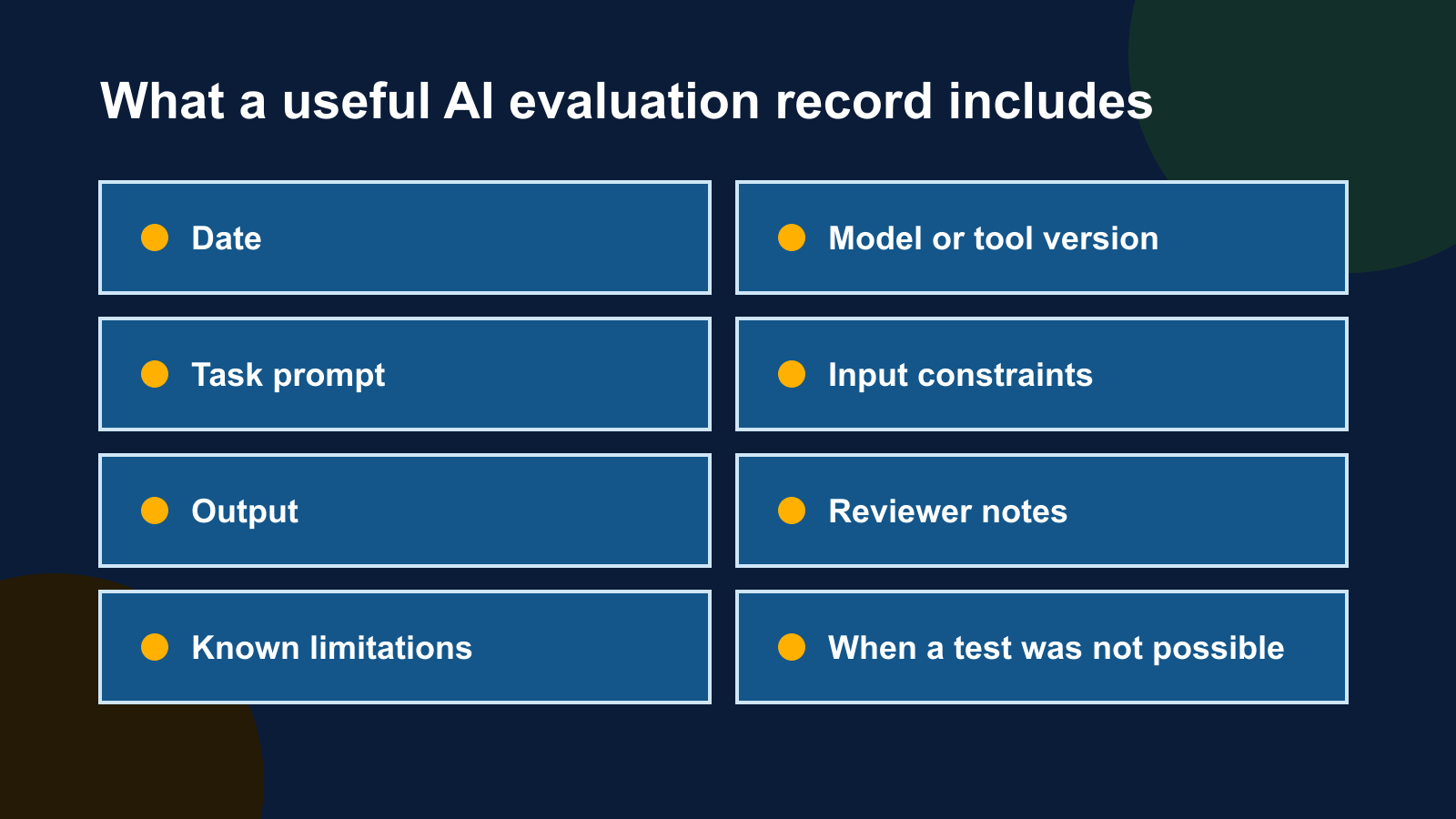
A useful evaluation record includes the date, model or tool version, task prompt, input constraints, output, reviewer notes and known limitations. It should also say when the test was not possible. Honest empty states are more useful than invented certainty.
What the future of AI means for a practical roadmap
A good roadmap does not try to predict every new model. It prepares for change without losing control. Start with one workflow that has a clear owner and a measurable outcome. Compare more than one tool. Protect sensitive data. Set a budget and an error policy. Keep a human approval step for high-impact actions. Re-test after a major model or pricing change.
Then ask what would make the project worth expanding. If the tool saves time without creating hidden review work, add the next narrow task. If quality is inconsistent, improve the data and evaluation before increasing scope. If the economics do not work, use a smaller model, a batch process or a non-AI method.
The future for AI is not simply more automation. It is a continuing negotiation between capability, cost, access, responsibility and human judgement. Teams that measure those trade-offs will be better placed than teams that treat every new release as a strategy.
The short answer
The future of AI points toward capable and cheaper systems, more local and open options, longer agent workflows, wider business use, heavier infrastructure demands and stronger governance. Those trends create opportunity, but they do not remove the need for testing and accountability.
The most durable approach is to choose a real task, use current sources, measure the result and preserve a clear way to review or stop the system. That is how the future with AI becomes practical rather than speculative.
Frequently asked questions
What is the future of AI?
The future of AI is likely to combine more capable models with cheaper inference, smaller systems, agent workflows, wider adoption and stronger expectations around safety, transparency and accountability. The speed and direction will vary by use case, region, cost and regulation.
Will AI replace all jobs?
No reliable source supports a single outcome for every job. AI can automate some tasks, change how work is organised and create demand for new skills, while many roles still require judgement, context, trust and responsibility. Evaluate tasks rather than treating a job title as a fixed unit.
What are the biggest AI trends to watch?
Watch model efficiency, open-weight systems, multimodal tools, AI agents, evaluation, infrastructure, governance and the distribution of benefits. These trends interact, so a more capable model is not automatically the best tool for a real workflow.
What will AI agents do in the future?
AI agents may handle longer sequences of work such as searching, drafting, coding or updating a system, but reliability depends on the task, permissions, tools, monitoring and the ability to recover from errors. Human review remains important for consequential work.
How can a business prepare for the future with AI?
Start with one measurable workflow, define acceptable errors, protect sensitive data, test several tools, keep an export or rollback path and measure the result. A small governed experiment is more useful than a vague promise to adopt AI everywhere.
Is the future of AI always positive?
No. AI can improve access to useful capabilities while also creating risks involving privacy, security, misinformation, bias, copyright and uneven access. The future depends partly on how organisations, users and policymakers manage those trade-offs.
Will smaller AI models replace the largest ones?
Not necessarily. Capable small systems and open-weight models can make local or specialised deployments practical, with benefits such as offline use, lower latency and data control. Larger hosted models may still suit other tasks, so the better question is which system meets the quality, cost and privacy needs of a specific workflow.
How should a team evaluate an AI tool?
Begin with a real task and a small representative sample, and define a quality threshold before looking at the result. Include difficult examples, then record the date, tool version, prompt, output, reviewer notes and known limitations. A benchmark score alone is not a complete product review.
Sources
Pages we read for this article, with the date we accessed each one.
- The 2025 AI Index Report, Stanford HAIaccessed November 2, 2026
- Technical Performance, The 2025 AI Index Report, Stanford HAIaccessed November 2, 2026
- AI Risk Management Framework, NISTaccessed November 2, 2026
- AI principles, OECDaccessed November 2, 2026
Related articles
AI Agents Examples: 20 Agents by Type, With Sources (2026)
AI agents examples by type: classic agents, everyday assistants, coding agents and workflow agents, with official sources and prices checked 2026-10-25.
Artificial Intelligence Companies in 2026: Who Builds What
The artificial intelligence companies that matter in 2026: model labs, chip makers and challengers, with dated plan prices, Indonesian support and sources.

Opensource AI: A Practical Guide to Models and Licenses
Opensource AI is more than downloadable weights. Learn how licenses, data information, code, parameters, and deployment choices shape real use.