
AI Agents Examples: 20 Agents by Type, With Sources (2026)
On this page
Short answer
The most useful AI agents examples in 2026 fall into four groups: classic agents from computer science (a thermostat, a self-driving car), everyday assistants that handle email, meetings and web tasks (Lindy, Zapier Agents, Perplexity's Comet), coding agents that edit a codebase and open pull requests (Claude Code, OpenAI Codex, Jules, GitHub Copilot, Cursor), and business workflow agents you build yourself (n8n, Gumloop, Activepieces). What they share is simple: you give a goal, and the system decides which steps and tools to use instead of following a fixed script.
Below, each example links to the official product page or documentation we checked on 2026-10-25, and every price comes from the vendor's pricing page on that date. To be clear about method: this is a sourced overview, not a hands-on test. We did not run these agents on real tasks for this article, so we describe what each vendor documents and point out where those claims need your own trial.
What counts as an AI agent (and what does not)
Many lists of AI agents mix three different things: chatbots that only answer, automations that follow fixed steps, and agents that decide. Separating them saves you from paying agent prices for a job a simple rule could do.
Anthropic's engineering guide, Building effective agents, draws the line clearly. Workflows are "systems where LLMs and tools are orchestrated through predefined code paths." Agents are "systems where LLMs dynamically direct their own processes and tool usage." The n8n documentation says the same thing in plainer words: a chain follows a predetermined sequence, while an agent "uses a language model to determine which actions to take."
So a practical test for any product calling itself an agent:
- Does it choose its own next step? If every step is drawn in a flowchart by you, it is a workflow, even if one step calls an AI model.
- Can it use tools? A browser, a terminal, your inbox, an API. Without tools, it can only talk.
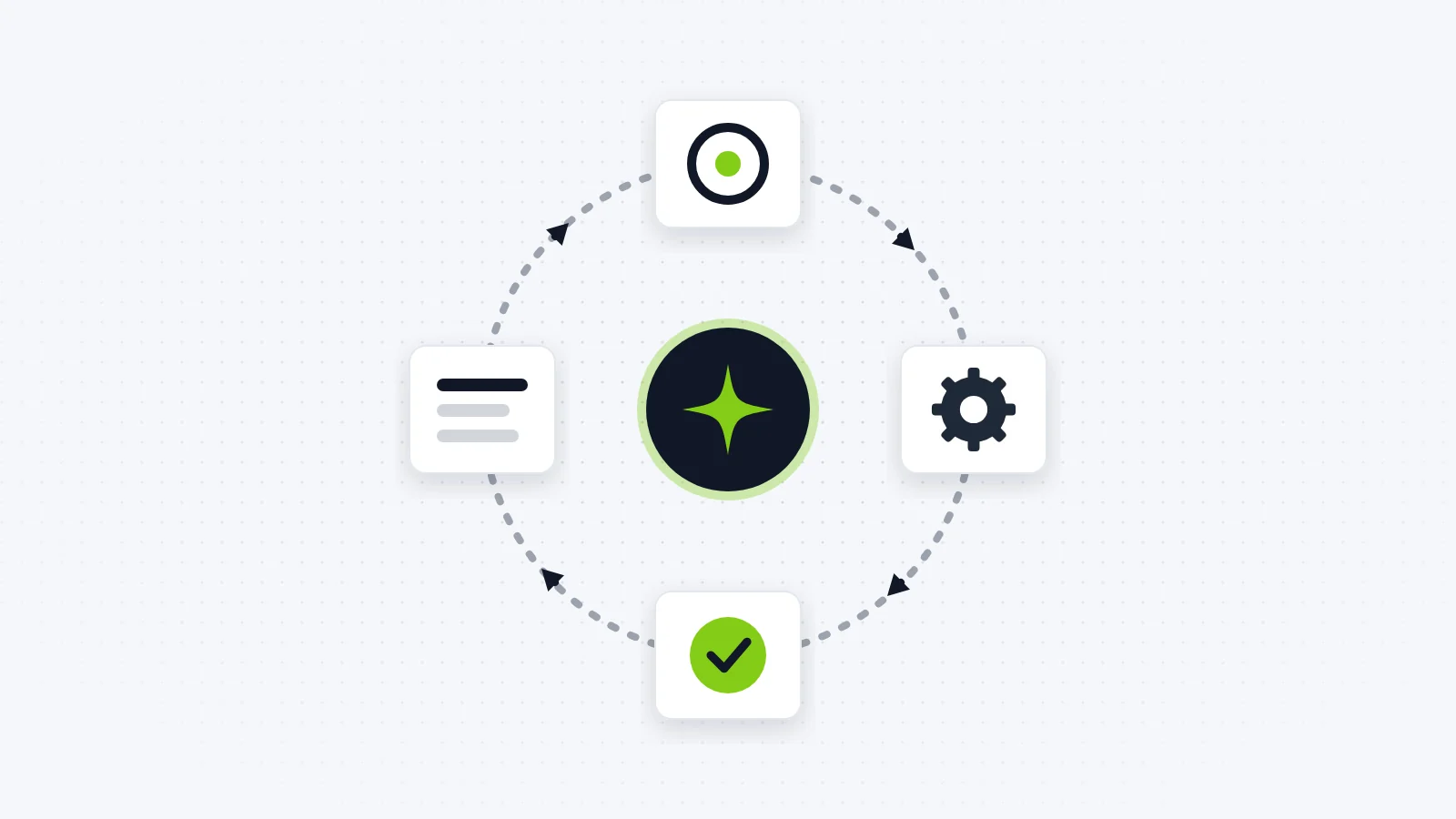
- Does it check results and try again? Agents loop: plan, act, look at the outcome, adjust.
Our view: "agent" has become a marketing label. Plenty of products sold as agents are well-made workflows, and that is not a criticism. Fixed steps are cheaper, faster and easier to audit. Anthropic's own guide recommends "finding the simplest solution possible, and only increasing complexity when needed," and notes that agentic systems "often trade latency and cost for better task performance."
The five classic types of AI agents, with examples
Before LLMs, computer science already had a taxonomy of agents. It still helps, because modern products map onto it. IBM's summary of AI agent types lists five, each with textbook examples.
| Agent type | How it decides | Classic example (IBM) | Modern equivalent |
|---|---|---|---|
| Simple reflex | Fixed if-then rules, no memory | Thermostat switching heat on below a set temperature | A rule-based Zap or email filter |
| Model-based reflex | Rules plus an internal picture of the world | Robot that remembers obstacles it already met | Support bot that keeps conversation context |
| Goal-based | Plans actions toward an objective | Robot planning a route to a specific room | Coding agent working toward "tests pass" |
| Utility-based | Scores outcomes and picks the best trade-off | Self-driving car balancing time, fuel and safety | Pricing engine weighing sales history and stock |
| Learning | Improves from feedback over time | Reinforcement-learning systems | Agents tuned on reviewed past runs |
The best-known real-world utility-based agent is probably a driverless car. Waymo describes itself as "the world's first autonomous ride-hailing service" and, on its homepage on 2026-10-25, listed 15 metro areas currently serving riders (including Phoenix, Los Angeles, the San Francisco Bay Area, Austin and Miami) and "20M+ rides served." That is an agent in the strict sense: it perceives, plans and acts in the physical world with no driver.
Most software agents you can buy today are goal-based. You state the goal, the model plans, and tools do the work. The "learning" part is usually weaker than marketing suggests. Many products remember your preferences, but few genuinely improve their strategy from outcomes without a human reviewing the results.
Everyday examples of AI agents for email, meetings and the web
This is the group most people mean when they search for AI agents examples: assistants that take routine work off your plate. For a ranked shortlist rather than examples, see our best AI agents page.
- Lindy calls itself "the AI employee that plugs into your tools, learns how you work, and takes real work off your plate." Documented tasks include drafting and replying to email, sharing meeting notes after calls and scheduling. Its pricing page lists 1,500+ integrations, MCP support and built-in approvals. New accounts get 50 USD in free credits that last 7 days, and the Team plan costs 49.99 USD per month for 5,000 credits, according to its pricing page.
- Zapier Agents let you "equip your Agents with company knowledge and have them do work across 9,000+ apps." Example agents on the page include a Meeting Prep Agent that builds a dossier on attendees, a Lead Qualification Agent and a Zendesk Ticket Agent that answers common questions and escalates complex ones. Zapier's pricing page shows a free plan with 100 tasks per month and Professional from 29.99 USD per month (19.99 USD per month billed yearly).
- Comet is Perplexity's browser, pitched as "the browser that works for you," available for Mac, Windows, iOS and Android. Browser agents like this act on the pages you visit, which is powerful and also the riskiest place for an agent to work. Our Perplexity profile covers the rest of its product line.
A dated lesson from ChatGPT
ChatGPT is the clearest proof that agent products change fast. OpenAI's help article on ChatGPT agent, checked on 2026-10-25, opens with: "ChatGPT agent is no longer available. Use ChatGPT Work for longer, multi-step tasks and finished deliverables." The same page still documents the safeguards OpenAI built in, including "user confirmations for high-impact actions," prompt injection monitoring and a "watch mode" requiring supervision on certain sites. See the OpenAI Help Center article.
If you are still choosing a general assistant before adding agents on top, our ChatGPT vs Gemini comparison and the ChatGPT alternatives page cover the base models.
Coding agents: the most mature category
Coding is where agents work best today, for a structural reason Anthropic's guide points out: code can be checked automatically. Tests either pass or fail, which gives the agent a clear feedback signal. Its guide describes coding agents resolving GitHub issues that need edits across many files, while noting that human review remains important.
| Agent | How you assign work | Where it runs | Entry price (checked 2026-10-25) |
|---|---|---|---|
| Claude Code | Describe a task in the terminal, IDE, desktop or web | Locally in your terminal, plus web and desktop | Not on Claude Free; Pro 20 USD/month (17 USD/month billed yearly) |
| OpenAI Codex | Prompt in ChatGPT, the editor, the terminal or the cloud | Local CLI and IDE, plus cloud | "Limited Codex access" on ChatGPT Free; Plus IDR 349,000/month (shown in IDR to a visitor from Indonesia) |
| Jules | Pick a GitHub repo and branch, or add a "jules" label to an issue | Cloud VM managed by Google | Base plan with 15 tasks per day; no prices listed on its page |
| GitHub Copilot | Agent mode in the editor, CLI agent or cloud agent | Editor, terminal and GitHub | Free tier; Pro 10 USD/month (plan details) |
| Cursor | Agent mode in the editor or cloud agents | Desktop editor and cloud | Free tier with limited agent requests; Plus 8 USD/month (Grok models only), cloud agents from Premium 30 USD/month |
The workflows differ more than the table suggests. Jules shows the classic agent loop on its homepage: it clones your repository to a cloud VM, drafts a plan you approve, shows a diff of the changes, and then you approve the PR and publish it on GitHub. Claude Code's page says it "plans, writes code, runs tests, and opens pull requests," and that it "asks for permission before making changes to your files or running commands." Devin Desktop, which windsurf.com now redirects to, is another option: its pricing page lists a Free plan with a "light quota to code with agents" and Pro at 20 USD per month.
Our take: the gap between these tools is less about raw model quality and more about where they fit your habits. Terminal-first developers lean toward Claude Code (see our Claude profile) or the Codex CLI. Teams that live in GitHub issues may prefer an agent you can assign by label. Compare current model rankings on our AI leaderboard, and see the full category in AI for coding.
Business workflow agents you build yourself
The fourth group is less a product than a pattern: you assemble an agent from a builder, connect your own apps and decide exactly which actions need a human. Common business examples:
- Customer support triage. Read incoming tickets, answer the routine ones from your docs, escalate the rest with a summary. Anthropic's guide calls support a natural fit because success is measurable (was the issue resolved?).
- Lead qualification. Enrich a form submission, score it and alert sales only for good fits.
- Meeting prep and follow-up. Research attendees before a call, then turn notes into tasks. Pair with tools from our AI note-taking list.
- Back-office classification. Sort expenses, route invoices, tag documents.
| Builder | Agent feature | Free entry point (checked 2026-10-25) | Paid from |
|---|---|---|---|
| n8n | AI Agent node, 600+ integrations as tools, self-hosting | Community Edition (self-hosted); cloud has a free trial, no free plan | Starter 20 EUR/month billed yearly |
| Gumloop | Unlimited agents, bring your own API keys, MCP hosting | 14-day Pro trial, no free plan | Pro 37 USD/month |
| Activepieces | Flows and agents, cloud or on-prem | Free plan, 1,000 credits per month | Plus 20 USD/month |
| Zapier | Agents across 9,000+ apps | Free plan, 100 tasks per month | Professional 29.99 USD/month |
Notice what is not in that table: Microsoft Power Automate. Its desktop flows are classic RPA (robotic process automation, meaning software that clicks through apps by recorded rules). In IBM's terms that sits closest to a simple reflex agent, and for stable, repetitive screens fixed rules are usually cheaper and easier to audit than an LLM agent.
For a broader shortlist, see AI for automation, or compare cheaper options on our Zapier alternatives page.
How to choose (and when not to use an agent)
After reading through the documentation for these 20-odd examples, our selection advice comes down to four questions.
- Can you write the steps down? If yes, build a workflow. It is cheaper, faster and repeatable. Use an agent only for the step where judgment is needed.
- Can the result be checked automatically? Code with tests, a form that validates, a ticket marked resolved. Agents do best where success is measurable.
- What is the worst action it could take? Sending email, paying, deleting and posting should require approval. OpenAI built confirmations for high-impact actions for a reason, and Lindy, n8n and Claude Code all advertise approval or permission controls.
- Who pays per run? Credits, tasks and executions are billed differently. Run a small pilot and read the usage log before scaling.
The contrarian point we keep coming back to: the best first agent for most teams is narrow and boring. One inbox, one ticket queue, one repository. Broad "do anything" agents make impressive demos, but they are harder to supervise, and every new tool you connect is another surface for prompt injection.
If you are new to AI tools in general, start with our guide on how to use AI, then browse free AI tools to experiment before paying. Developers who want to build their own agent from scratch can read our AI API guide.
Keeping this list current
Agent products rename, merge and retire features faster than almost any other software category, as the ChatGPT example above shows. We keep tool profiles in our AI tools directory with a source link and a "checked on" date beside every price, and facts older than 90 days are flagged for re-check. For model scores, and for the Bahasa Indonesia benchmark (NS-ID) we are building, see our benchmarks pages.
When you pick an agent from these examples, run it on one real task you already know the answer to. That single test will tell you more than any list, including this one.
Frequently asked questions
What are some examples of AI agents?
Everyday examples include Lindy and Zapier Agents for email, meetings and business tasks, and Perplexity's Comet browser for web tasks. Coding examples include Claude Code, OpenAI Codex, Jules, GitHub Copilot's cloud agent and Cursor. Physical examples include Waymo's driverless ride-hailing cars. Classic textbook examples include a thermostat (simple reflex agent) and a navigation robot (goal-based agent).
What is the difference between an AI agent and an automation workflow?
In a workflow, you define every step in advance and the system follows that path. In an agent, a language model decides which steps and tools to use while it works. Anthropic describes workflows as LLMs and tools orchestrated through predefined code paths, and agents as systems where LLMs dynamically direct their own processes and tool usage.
Is ChatGPT an AI agent?
A plain chat reply is not an agent, because the model only answers. ChatGPT has offered agent features that browse, run tasks and use connected apps. As of 2026-10-25, OpenAI's help center says the earlier ChatGPT agent is no longer available and points users to ChatGPT Work for longer, multi-step tasks.
What are the five types of AI agents?
The classic taxonomy, summarized by IBM, lists simple reflex agents, model-based reflex agents, goal-based agents, utility-based agents and learning agents. Most modern LLM agents combine goal-based planning with tools, and some add learning from feedback.
Can I try an AI agent for free?
Several have free entry points. Zapier has a free plan with 100 tasks per month, Activepieces has a free plan with 1,000 credits per month, n8n's Community Edition can be self-hosted, Jules has a base plan with 15 tasks per day, and Lindy starts new accounts with 50 USD in credits that last 7 days. Check each pricing page, since limits change.
Are AI agents safe to give access to my accounts?
Treat them like a new contractor. Agents that act on websites and accounts are exposed to prompt injection, where hidden text tries to redirect them. OpenAI lists user confirmations for high-impact actions and a supervised watch mode among its safeguards, and Claude Code asks permission before changing files or running commands. Start with read-only access and require approval for anything that sends, pays or deletes.
Sources
Pages we read for this article, with the date we accessed each one.
- Types of AI Agents, IBMaccessed October 25, 2026
- Building effective agents, Anthropic (December 19, 2024)accessed October 25, 2026
- What agents do, n8n Docsaccessed October 25, 2026
- AI agents, n8naccessed October 25, 2026
- ChatGPT agent, OpenAI Help Centeraccessed October 25, 2026
- Waymoaccessed October 25, 2026
- Zapier Agentsaccessed October 25, 2026
- Zapier pricingaccessed October 25, 2026
- Lindyaccessed October 25, 2026
- Lindy pricingaccessed October 25, 2026
- Comet browser, Perplexityaccessed October 25, 2026
- Claude Code, Anthropicaccessed October 25, 2026
- Claude pricingaccessed October 25, 2026
- Codex, OpenAIaccessed October 25, 2026
- Jules, Googleaccessed October 25, 2026
- GitHub Copilot plansaccessed October 25, 2026
- Cursor pricingaccessed October 25, 2026
- n8n pricingaccessed October 25, 2026
- Gumloop pricingaccessed October 25, 2026
- Activepieces pricingaccessed October 25, 2026
- ChatGPT pricing, OpenAIaccessed October 25, 2026
- Devin pricing (windsurf.com redirects here)accessed October 25, 2026
- Power Automate pricing, Microsoftaccessed October 25, 2026
Related articles
How to Use AI: A Practical Beginner's Guide (2026)
Learn how to use AI step by step: pick one assistant, write clear prompts, check every answer, and set up your own AI helper without training a model.
Starting a Startup in 2026: A Step-by-Step Guide for Small Teams
A practical guide to starting a startup: find a real problem, validate it, build a no-code or AI-built MVP, handle setup and funding, and launch. Tool prices checked 2026-10-25.
Artificial Intelligence Companies in 2026: Who Builds What
The artificial intelligence companies that matter in 2026: model labs, chip makers and challengers, with dated plan prices, Indonesian support and sources.