
AI Data Center: What It Is, How It Works and Why It Matters
On this page
Short answer
An AI data center is a building designed to train and run artificial intelligence models. It holds thousands of GPUs or other AI accelerators, the fast networks that tie them together, and the power and cooling systems that keep them running. IBM describes it as a facility with "advanced compute, network and storage architectures and energy and cooling capabilities to handle AI workloads." Every answer you get from ChatGPT, Claude or Gemini is computed in one of these buildings.
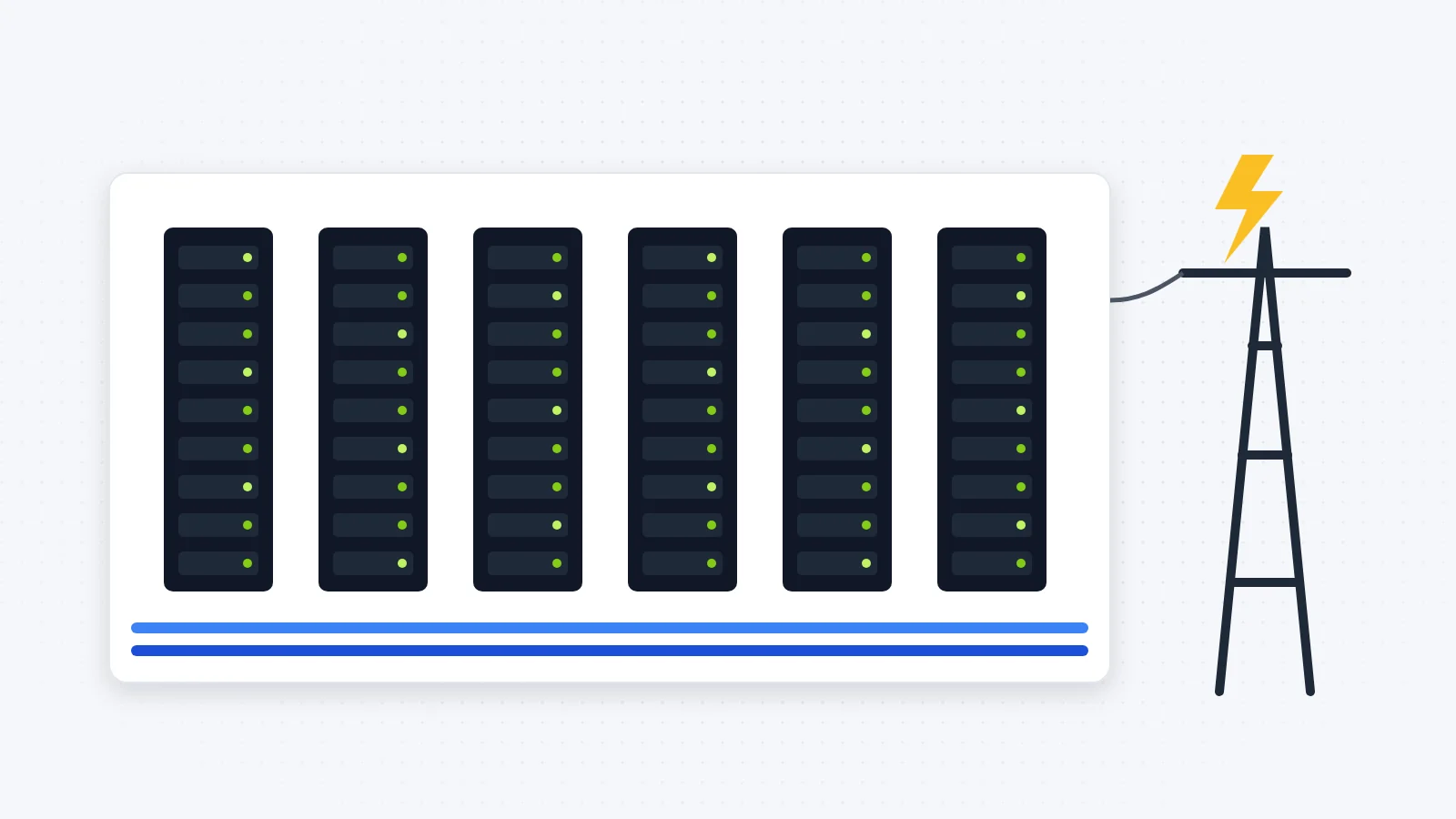
This guide explains what is inside an AI data center, how it differs from a regular one, how much electricity the sector uses, and who is building the largest sites. We also cover the part most explainers skip: what this infrastructure means for people who simply use AI tools every day. Every figure below links to the official source we checked on 25 October 2026.
What is an AI data center?
A data center is a secure building full of servers, storage and network equipment. An AI data center is the same idea, rebuilt around one job: running the enormous number of calculations that machine learning needs.
That job comes in two forms:
- Training: teaching a model by feeding it huge datasets. This can keep tens of thousands of chips busy for weeks.
- Inference: running the finished model to answer prompts, write code or generate images. This is what happens every time you press Enter in a chatbot.
IBM points out that a traditional data center "would quickly be overwhelmed by AI workloads," because it is usually designed around CPUs (general-purpose processors). An AI facility instead relies on GPUs and specialized accelerators such as TPUs, which split a problem into many small pieces and solve them at the same time.
Here is our view after tracking AI tools for Newly Stack: the term "AI data center" is now as much a marketing label as a technical one. Plenty of existing sites get a few GPU racks and a press release. What actually separates a purpose-built facility is power density and cooling. If a building cannot deliver far more electricity per rack and remove the heat that comes with it, it is a regular data center with some AI hardware inside.
AI center, center for AI and AI in data centers
People search for these phrases interchangeably, but they mean different things.
AI center or center for AI usually refers to an organization, not a building of servers. The Center for AI Safety in San Francisco, for example, describes itself as a research and field-building nonprofit focused on reducing societal-scale risks from AI. Many universities run their own AI centers for research and teaching.
AI in data centers flips the topic around: using AI to run the facility itself. A well-known early example comes from 2016, when Google DeepMind reported that applying machine learning to Google data centers cut the energy used for cooling by up to 40 percent. Operators now apply similar ideas to cooling, maintenance planning and workload scheduling.
So an AI data center is the infrastructure that runs AI, "AI in data centers" is AI helping operate that infrastructure, and a "center for AI" is usually a research group. Keeping these straight makes the news coverage in the rest of this guide easier to follow.
AI data center vs traditional data center
The two share a lot. Both need security, reliability, backup power and good networking. The differences show up in the hardware and in what the building must supply to that hardware.
| Feature | Traditional data center | AI data center |
|---|---|---|
| Main processors | CPUs | GPUs, TPUs and other AI accelerators |
| Typical workload | Websites, databases, email, business apps | Model training and inference |
| Interconnect | Standard Ethernet between servers | Very high bandwidth links between chips (for example NVLink, InfiniBand) |
| Cooling | Mostly air cooling | Increasingly liquid cooling for dense racks |
| Power per rack | Lower | Much higher, which shapes site selection |
| Memory | Standard server RAM | High-bandwidth memory (HBM) on accelerators |
IBM also separates two business models you will see in the news. Hyperscale data centers are giant facilities run by cloud providers such as AWS, Microsoft Azure and Google Cloud; IBM defines them as having at least 5,000 servers and 10,000 square feet. Colocation means one company owns the building and rents space, power and connectivity to others. Most companies never build their own AI data center. They rent capacity from these operators, often through a cloud API.
Inside an AI data center: chips, networks and cooling
Accelerators
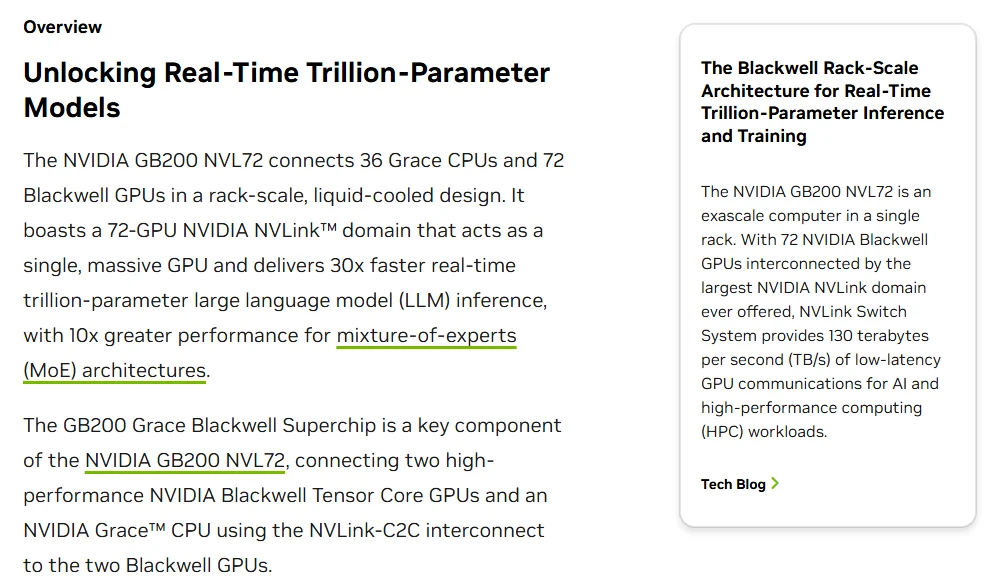
The heart of the building is the accelerator. NVIDIA's GB200 NVL72 is a good example of where the industry is heading: it connects 36 Grace CPUs and 72 Blackwell GPUs in a single liquid-cooled rack, which NVIDIA calls "an exascale computer in a single rack." Google uses its own TPUs, and other providers are designing custom chips too.
NVIDIA is not the only option, and that matters for anyone comparing data center AI capacity between providers. Anthropic says it trains and runs Claude on three hardware families: AWS Trainium, Google TPUs and NVIDIA GPUs, matching each workload to the chip that suits it. In our reading, this mixed approach is becoming the norm for large labs, because relying on a single chip supplier turns every shortage into a product delay.
Networking
Large models do not fit on one chip, so the chips must talk to each other constantly. NVIDIA says the NVLink Switch System in that rack provides 130 TB/s of GPU-to-GPU communication. Slow links leave expensive chips waiting, which is why networking is a first-class design problem in AI facilities rather than an afterthought.
Cooling and efficiency
Packing that much compute together creates a lot of heat. NVIDIA states that liquid cooling "increases compute density, reduces the amount of floor space used" and supports the fast links between GPUs. IBM notes that liquid cooling handles high-density heat better than air and can improve power usage effectiveness.
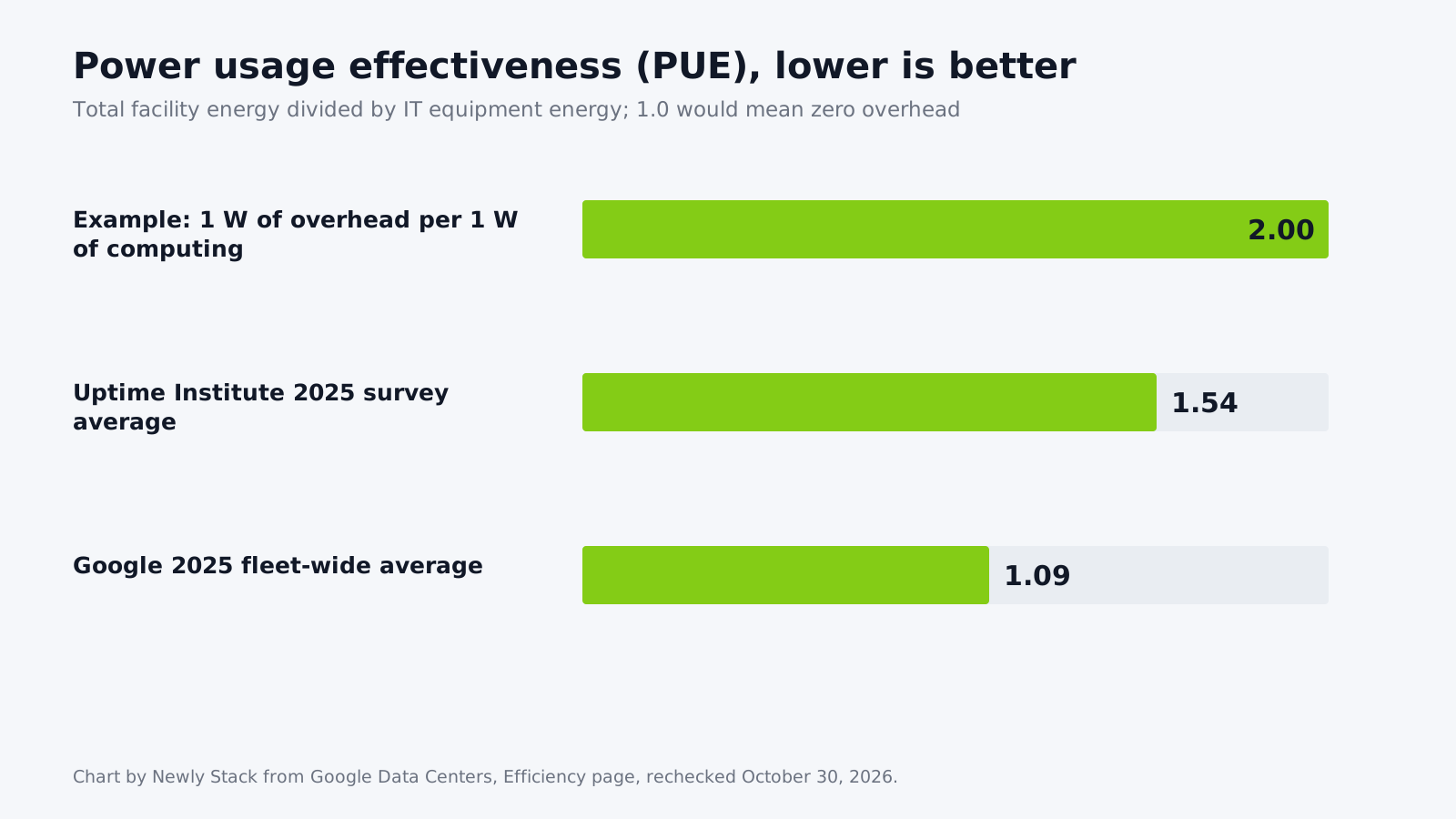
Power usage effectiveness (PUE) is the standard efficiency ratio: total facility energy divided by the energy used by IT equipment. A PUE of 2.0 means one extra watt for cooling and power distribution for every watt of computing. Google reports a 2025 fleet-wide average PUE of 1.09, and cites the Uptime Institute's 2025 survey average of 1.54 for comparison.
Why AI data centers use so much electricity
This is the topic that pulls the most search interest, and for good reason.
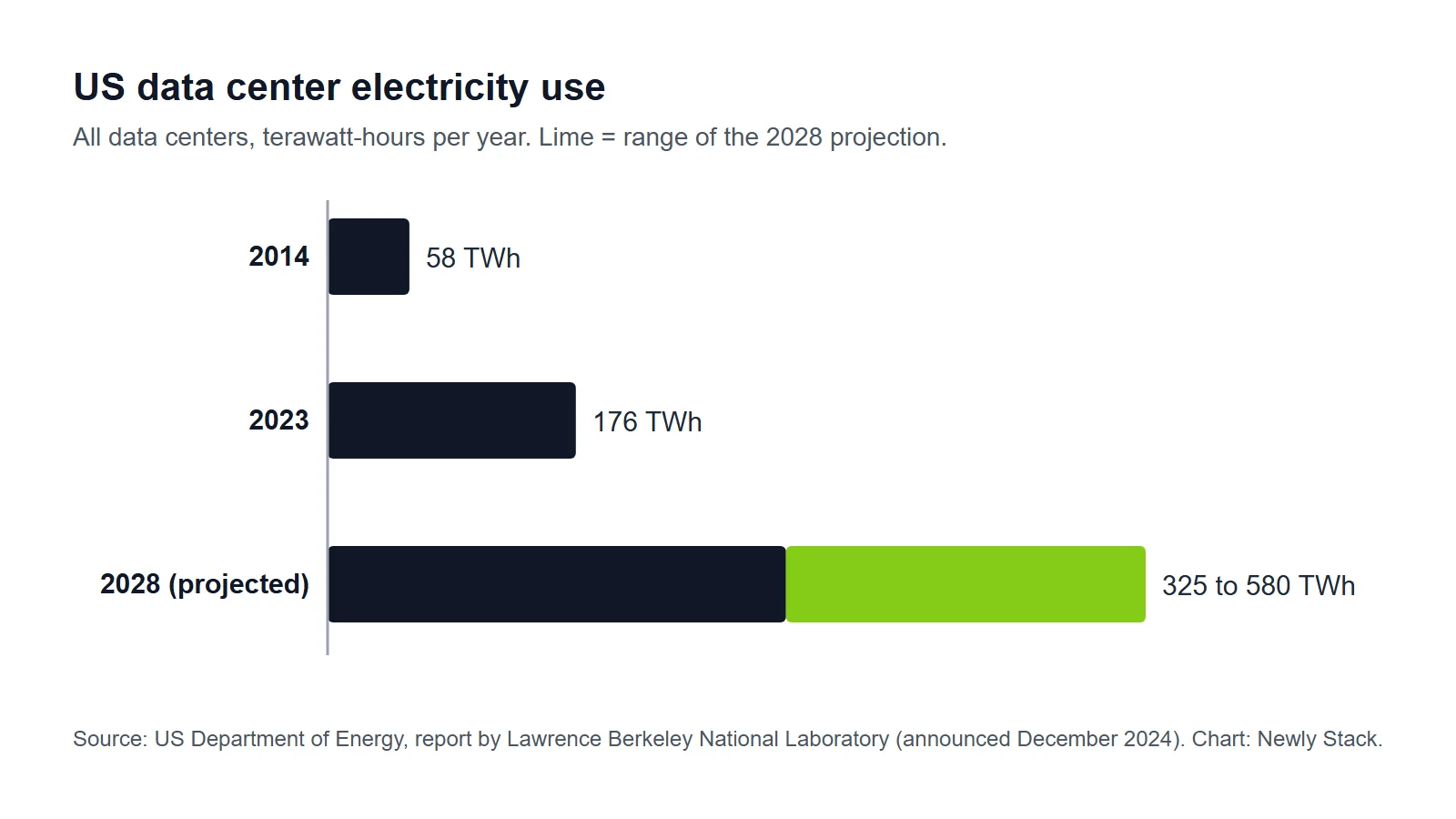
In the United States, the Department of Energy reported findings from a Lawrence Berkeley National Laboratory study: data centers used about 4.4% of total US electricity in 2023, and could use about 6.7% to 12% by 2028. Total data center usage rose from 58 TWh in 2014 to 176 TWh in 2023, with a projected 325 to 580 TWh by 2028. Those figures cover all data centers, not only AI ones, but AI is the main reason the curve bends upward.
Globally, the International Energy Agency's Energy and AI report projects that data center electricity demand will more than double to around 945 TWh by 2030, as summarized by the American Public Power Association. The same report expects demand from AI-optimized data centers to more than quadruple by 2030, and says US data centers are on course to account for almost half of US electricity demand growth over that period.
Two nuances are worth keeping in mind:
- The ranges are wide. DOE's 2028 estimate spans roughly 6.7% to 12%. The IEA itself stresses uncertainty about AI adoption, efficiency gains and energy bottlenecks. Anyone quoting a single precise number for 2030 is overselling.
- Efficiency keeps moving. Google says its data centers delivered over three times more compute per unit of energy in 2025 than five years earlier, mostly thanks to TPU efficiency. NVIDIA claims GB200 delivers 25x more performance than H100 air-cooled infrastructure at the same power. Treat vendor numbers as vendor claims, but the direction is real.
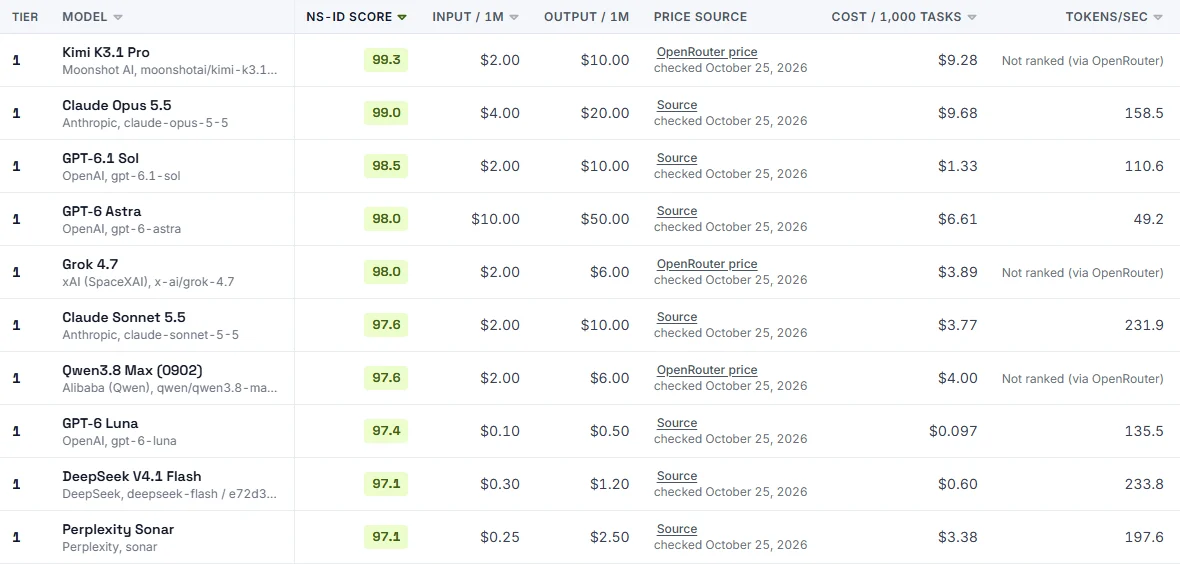
Our take: the honest headline is not "AI will eat the grid" or "AI is fine." It is that the electricity bill depends heavily on how efficiently models are built and served, which is one reason our LLM leaderboard shows price per million tokens and our own measured speed next to quality scores.
Who is building the biggest AI data centers?
Investment announcements arrive almost weekly. The table below lists only commitments we could confirm on the companies' own pages. Treat these as announced plans, not finished buildings.
| Company | Announced commitment | Where | Official source |
|---|---|---|---|
| OpenAI with SoftBank, Oracle and MGX (Stargate) | $500 billion over four years, 10 GW target; nearly 7 GW planned by Sept 2025 | United States, flagship in Abilene, Texas | Stargate announcement, five new sites |
| Microsoft | About $80 billion in FY2025 on AI-enabled datacenters, more than half in the US | Global | Microsoft On the Issues |
| Anthropic with Fluidstack, then Google and Broadcom | $50 billion in US computing infrastructure, sites coming online through 2026; in April 2026, a further deal for multiple gigawatts of TPU capacity expected from 2027 | Texas and New York; most new capacity in the US | Nov 2025 announcement, Apr 2026 announcement |
The Stargate numbers show how fast the scale has changed. OpenAI's January 2025 announcement said it would deploy $100 billion immediately. By September 2025, five new sites plus Abilene and CoreWeave projects brought Stargate to "nearly 7 gigawatts of planned capacity." Capacity is now announced in gigawatts of power, not in server counts, which tells you what the real constraint is.
If you want the business side of this race (who is ahead, who is spending), see our overview of artificial intelligence companies and our explainer on frontier AI. For the Chinese side of the market, read our guide to Chinese AI.
What AI data centers mean for people who use AI tools
Most articles about AI infrastructure stop at power plants and chip counts. At Newly Stack we care about the user end of the pipe, because that is where the infrastructure shows up in your day.
Rate limits and plan tiers
Compute capacity is finite. When providers are short on GPUs, it tends to show up as usage caps, slower responses at peak times, or new features arriving on paid tiers first. We cannot see inside any provider's capacity planning, so we will not claim a direct link for a specific limit. The practical advice still holds: if your work depends on one assistant, keep a second one ready. Our ChatGPT alternatives page and the ChatGPT vs Gemini comparison are good starting points. For current plan prices, check each tool's page in our AI tools directory, where every price carries its source and check date.
Price per token and speed
Every API price you pay per million tokens ultimately covers chips, electricity and buildings. That cost shows up differently by provider and model size, which is why cheaper, smaller models are often the sensible default for routine tasks. On our LLM leaderboard we list each model's official price per million tokens with its source and date, plus speed we measure ourselves (time to first token and tokens per second), with the test server location recorded. Distance to the data center is one of the factors behind response time, so where a test runs matters.
Where your data lives
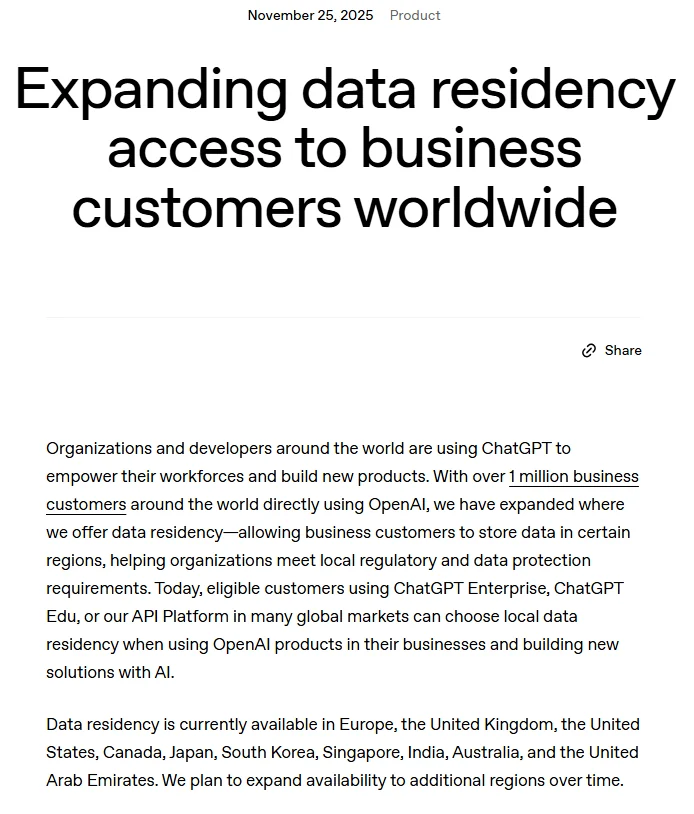
Data center location matters for compliance. OpenAI says data residency for eligible ChatGPT Enterprise, ChatGPT Edu and API customers is available in Europe, the UK, the US, Canada, Japan, South Korea, Singapore, India, Australia and the UAE. When we checked on 25 October 2026, Indonesia was not on that list. That matters for Indonesian companies with local data rules, and it is a question worth asking any vendor before signing.
Language quality is a separate question
A bigger AI data center does not automatically mean a model handles your language well. Training data and evaluation choices matter more. That is why we run our own AI benchmarks, including a Bahasa Indonesia test, instead of assuming that the company with the most gigawatts also gives the best answers.
The bottom line
An AI data center is where modern AI actually happens: dense racks of GPUs or TPUs, fast interconnects, liquid cooling and a very large electricity connection. The official numbers show rapid growth in power demand, with wide uncertainty bands, and the investment commitments now run to hundreds of billions of dollars and multiple gigawatts.
For everyday users, the useful takeaway is simpler. Infrastructure decides how much AI capacity exists and where your data can live. It does not decide which tool is best for your task. For that, use tested and dated comparisons: start with our LLM leaderboard, then check a tool's current price and terms in the AI tools directory before you commit.
Frequently asked questions
What is an AI data center?
An AI data center is a facility that houses the computing, storage, networking, power and cooling needed to train and run AI models. Its defining feature is a large number of GPUs or other AI accelerators packed densely together, which pushes power and cooling needs far beyond a regular server hall.
How is an AI data center different from a normal data center?
Both hold servers, storage and network gear. A traditional data center is mostly built around CPU servers and air cooling. An AI data center is built around GPU or TPU clusters linked by very fast interconnects, often with liquid cooling, and it needs much more electricity per rack.
How much electricity do AI data centers use?
In the United States, all data centers used about 4.4% of national electricity in 2023 and could reach 6.7% to 12% by 2028, according to a DOE report produced by Lawrence Berkeley National Laboratory. Globally, the IEA projects data center demand to more than double to around 945 TWh by 2030, with AI-optimized facilities growing fastest.
What is the biggest AI data center project?
Among the projects we could confirm on official pages, OpenAI's Stargate has the biggest published numbers: a $500 billion, 10-gigawatt commitment, with nearly 7 gigawatts of planned capacity announced by September 2025 and a flagship site in Abilene, Texas. We have not verified every project worldwide, and sizes change quickly, so check the companies' own announcements for current figures.
Is 'center for AI' the same as an AI data center?
No. 'Center for AI' usually refers to a research institute or nonprofit, such as the Center for AI Safety in San Francisco. An AI data center is physical infrastructure: buildings full of chips, power and cooling equipment.
Does the location of AI data centers affect me as a user?
It can. Where a provider stores and processes data matters for compliance. OpenAI, for example, lists specific regions where eligible business and API customers can keep data at rest in-region; Indonesia was not on that list when we checked on 25 October 2026.
What is PUE in a data center?
Power usage effectiveness (PUE) is total facility energy divided by the energy used by IT equipment. A PUE of 2.0 means one extra watt for cooling and power distribution for every watt of computing. Google reports a 2025 fleet-wide average PUE of 1.09 and cites the Uptime Institute 2025 survey average of 1.54 for comparison. PUE only measures overhead, not total electricity use.
Why do AI data centers use liquid cooling?
Because AI racks pack a lot of compute, and heat, into a small space. NVIDIA says liquid cooling increases compute density, reduces floor space and supports the fast links between GPUs; its GB200 NVL72 puts 36 Grace CPUs and 72 Blackwell GPUs in one liquid-cooled rack. IBM notes that liquid cooling handles high-density heat better than air and can improve power usage effectiveness.
Sources
Pages we read for this article, with the date we accessed each one.
- What is an AI data center? (IBM Think)accessed October 25, 2026
- DOE Releases New Report Evaluating Increase in Electricity Demand from Data Centers (U.S. Department of Energy)accessed October 25, 2026
- Electricity Demand from Data Centers Worldwide Set to More than Double by 2030: IEA (American Public Power Association)accessed October 25, 2026
- NVIDIA GB200 NVL72 (NVIDIA)accessed October 25, 2026
- Data center efficiency (Google Data Centers)accessed October 25, 2026
- Announcing The Stargate Project (OpenAI)accessed October 25, 2026
- OpenAI, Oracle, and SoftBank expand Stargate with five new AI data center sites (OpenAI)accessed October 25, 2026
- Anthropic invests $50 billion in American AI infrastructure (Anthropic)accessed October 25, 2026
- Anthropic expands partnership with Google and Broadcom for multiple gigawatts of next-generation compute (Anthropic)accessed October 25, 2026
- The Golden Opportunity for American AI (Microsoft On the Issues)accessed October 25, 2026
- Expanding data residency access to business customers worldwide (OpenAI)accessed October 25, 2026
- DeepMind AI Reduces Google Data Centre Cooling Bill by 40% (Google DeepMind)accessed October 25, 2026
- Center for AI Safetyaccessed October 25, 2026
Related articles
Artificial Intelligence Companies in 2026: Who Builds What
The artificial intelligence companies that matter in 2026: model labs, chip makers and challengers, with dated plan prices, Indonesian support and sources.
How to Use AI: A Practical Beginner's Guide (2026)
Learn how to use AI step by step: pick one assistant, write clear prompts, check every answer, and set up your own AI helper without training a model.
Frontier AI: What It Means, Who Builds It, and How to Judge It
Frontier AI explained with dated facts: official definitions, the compute thresholds regulators use, flagship models and API prices, and how to test them.