
Artificial Intelligence Companies in 2026: Who Builds What
On this page
Short answer
The artificial intelligence companies that matter most in 2026 fall into three groups: frontier model labs (OpenAI, Google, Anthropic, Meta, xAI), the chip and cloud companies that supply compute (NVIDIA, Google, Amazon Web Services, Microsoft), and a fast-moving group of challengers led by DeepSeek, Alibaba's Qwen team, Moonshot AI and Mistral. This guide maps who builds what, which products you can actually use today, what they cost, and which ones officially support Bahasa Indonesia. Every price and fact below was checked on 2026-10-25 against the source linked next to it.
Most "top AI companies" lists rank firms by market value or hype. We think that misses the point for anyone choosing a tool. A company's size tells you little about whether its chatbot handles your language well, or whether its free plan is usable. So we sort companies by layer, then show the product you would touch.
What counts as an artificial intelligence company?
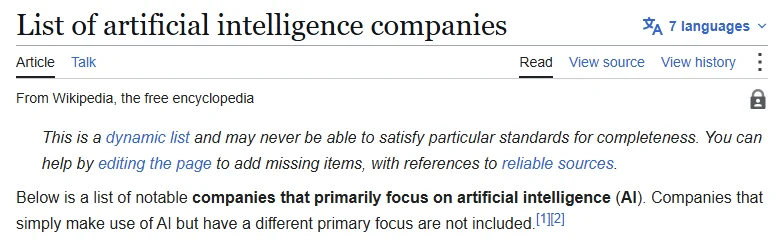
There is no official definition, so it helps to borrow a strict one. Wikipedia's list of artificial intelligence companies only includes "companies that primarily focus on artificial intelligence" and leaves out companies that "simply make use of AI but have a different primary focus." By that rule, OpenAI and Anthropic qualify, while a bank with a chatbot does not.
That rule is useful, but it hides the biggest players. Google, Microsoft, Amazon and Meta are not "primarily" AI companies, yet they fund, train and ship some of the most used models in the world. So in practice we look at three layers:
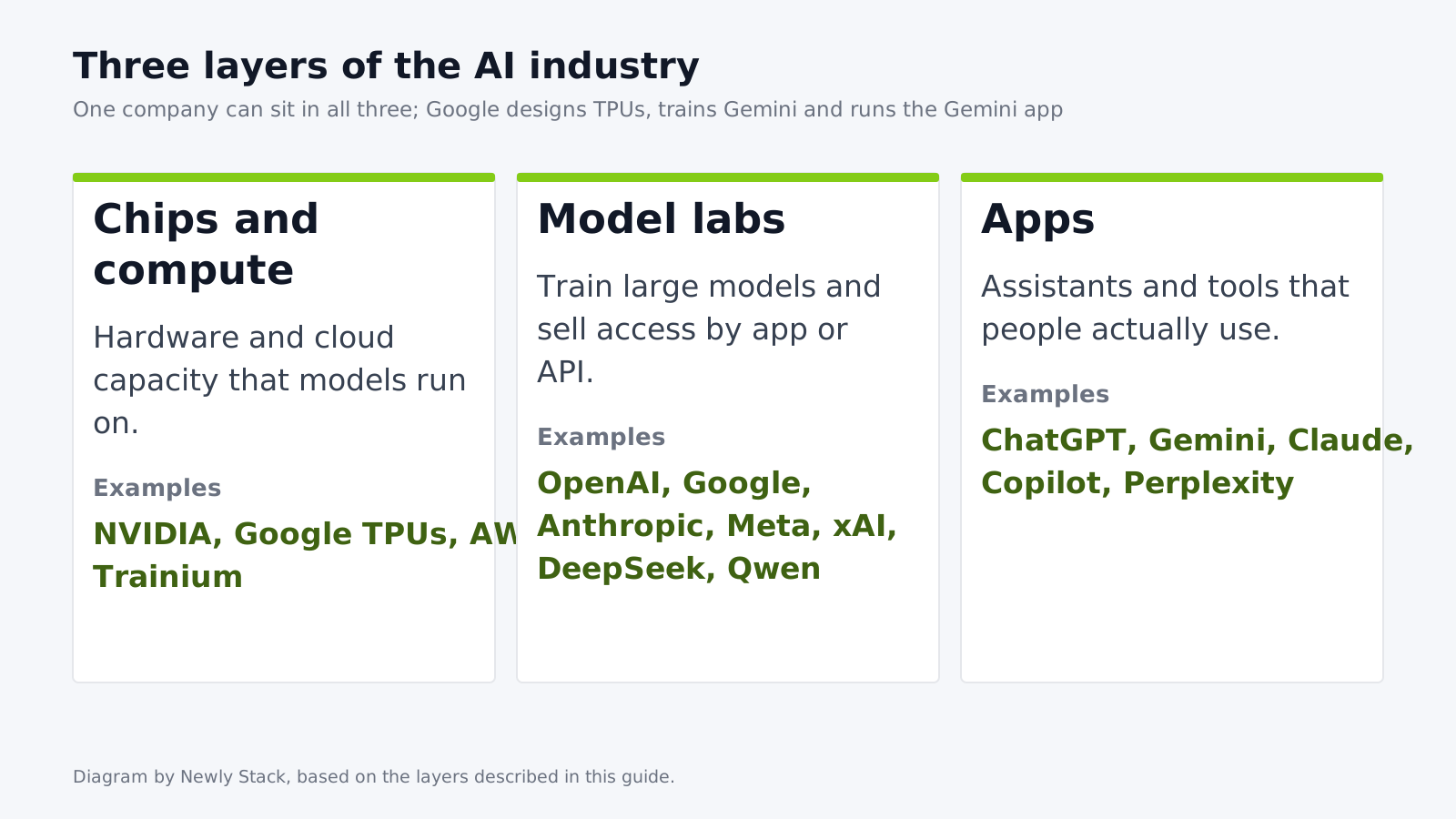
- Chips and compute. The hardware and cloud capacity that models are trained and run on.
- Model labs. Teams that train large models and sell access through an app or an API (a programming interface that lets other software call the model).
- Apps. The chat assistants, coding tools, image and video generators that ordinary people and companies with AI budgets actually use.
A single firm can sit in all three. Google designs its own AI chips (TPUs), builds the Gemini models and runs the Gemini app. Others, like Perplexity, mostly live in the app layer and build on models from several labs.
The largest AI companies, sorted by layer
The table below covers the artificial intelligence companies behind the assistants most people try first. "Indonesian support" means the company's own help page lists Indonesian; "not confirmed" means we looked and found no official list naming it. The free plan column reflects our directory check on 2026-10-25.
| Company | Main AI product | Free plan | Indonesian officially listed |
|---|---|---|---|
| OpenAI | ChatGPT | Yes | Yes (OpenAI Help) |
| Gemini | Yes | Yes (Gemini Help) | |
| Anthropic | Claude | Yes | Yes (Claude Help) |
| Microsoft | Copilot | Yes | Yes, for prompts and responses (Microsoft Support) |
| Meta | Meta AI | Yes | Not confirmed |
| xAI | Grok | Yes | Not confirmed |
| Mistral AI | Vibe, formerly Le Chat | Yes | Not confirmed |
| DeepSeek | DeepSeek chat | Yes | Not confirmed |
| Alibaba (Qwen) | Qwen Chat | Yes | Model family lists Indonesian (Qwen3 blog) |
| Moonshot AI | Kimi | Yes | Not confirmed |
| Perplexity AI | Perplexity | Yes | Not confirmed |
US frontier labs
OpenAI, Google, Anthropic, Meta and xAI train the largest general models. They compete on reasoning, coding and multimodal features (handling images, audio and video, not just text). If you want a head-to-head view of the two most used assistants, our ChatGPT vs Gemini comparison goes feature by feature. For a wider look at which labs are pushing the ceiling, see our explainer on frontier AI.
Chinese and open-weight challengers
DeepSeek, Alibaba's Qwen team and Moonshot AI are the names to watch. Several of them publish model weights, meaning anyone can download and run the model. DeepSeek, for example, lists its V4 and V4.1 models on its Hugging Face page, and the Qwen team released six Qwen3 dense models under the Apache 2.0 license. We cover this group in depth in our guide to Chinese AI.
Europe and everyone else
Mistral AI in France is Europe's best known model lab. Its assistant was renamed from Le Chat to Vibe, and the product page now says "Le Chat is now Vibe." The Wikipedia list also names Cohere (Canada), DeepL and Aleph Alpha (Germany), Stability AI (UK), Sakana AI (Japan) and AI21 Labs (Israel), most of which focus on narrower products or business customers.
AI chip companies and the compute layer
Every chatbot answer runs on specialised hardware, and a handful of AI chip companies control most of it. NVIDIA is the default choice for training and running large models; its data center page now leads with the Rubin platform, alongside the Blackwell and Hopper generations that power much of today's capacity.
The large cloud providers are also building their own chips to reduce that dependence:
- Google designs Tensor Processing Units (TPUs) and rents them through Google Cloud.
- Amazon Web Services sells Trainium, which AWS describes as "a purpose-built AI chip" aimed at the economics of training and inference (running a trained model to produce answers).
Large labs increasingly buy from several of these suppliers at once. Anthropic says it trains and runs Claude on AWS Trainium, Google TPUs and NVIDIA GPUs. In April 2026 it signed a further agreement with Google and Broadcom for multiple gigawatts of next-generation TPU capacity, which it expects to come online starting in 2027. In our view, that mix is a hedge: a lab tied to one chip supplier inherits every shortage that supplier has.
Why should a regular user care? Because compute cost flows straight into subscription prices and free-plan limits. When a free tier tightens, the reason is often the hardware bill behind it. Geography matters too: Stanford HAI's 2026 AI Index reports that "the United States hosts 5,427 data centers, more than 10 times any other country." For more on where that capacity lives and what it costs to run, read our piece on the AI data center build-out.
The AI industry by the numbers
The most reliable yearly snapshot of the AI industry is Stanford HAI's AI Index. Its 2026 edition contains several figures that explain why the list of serious artificial intelligence companies keeps getting longer:
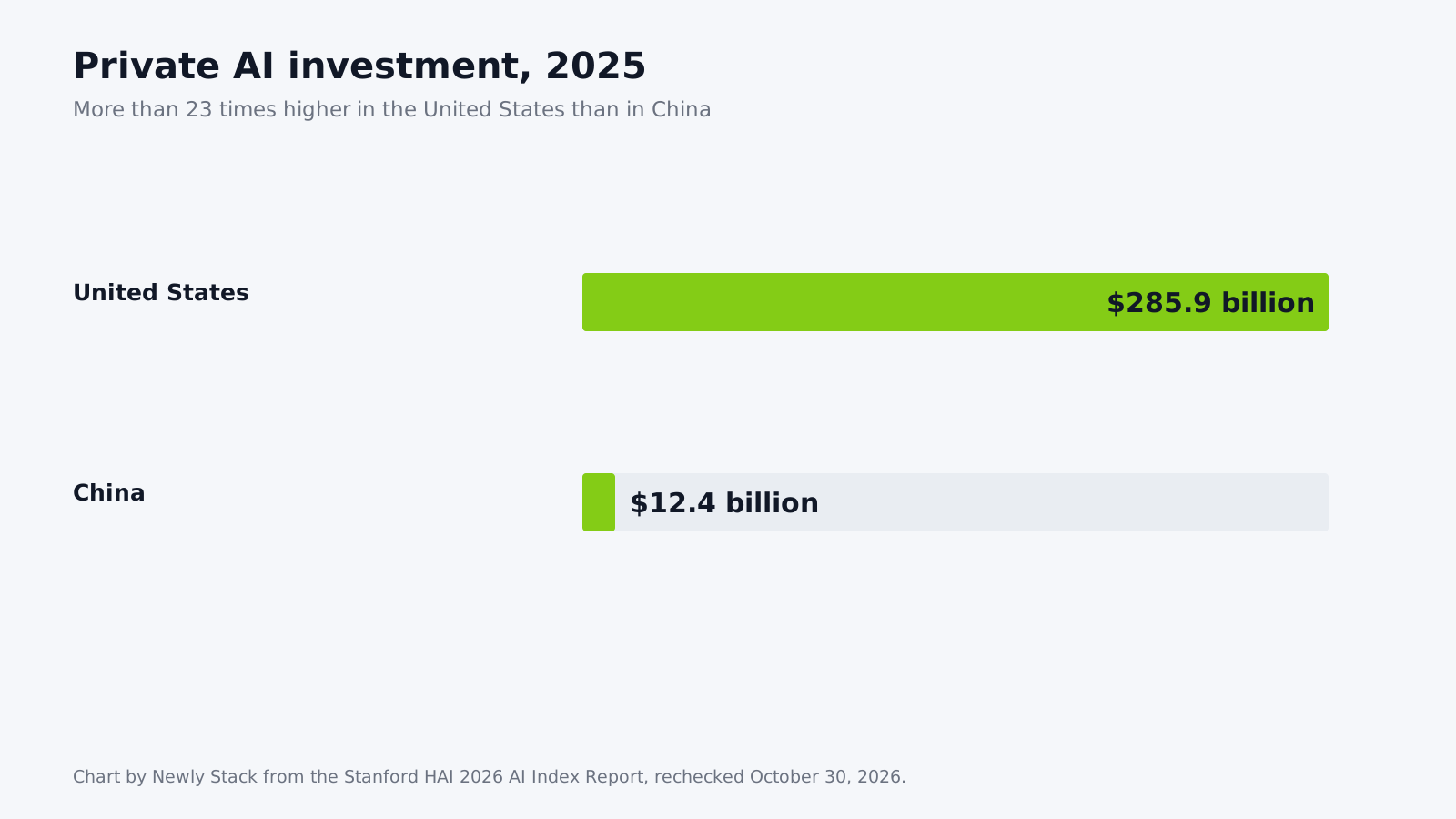
- Money. "U.S. private AI investment reached $285.9 billion in 2025, more than 23 times the $12.4 billion invested in China." The report also counts "1,953 newly funded AI companies in 2025" in the US.
- Who builds the models. "Industry produced over 90% of notable frontier models in 2025." Universities and governments are now mostly users and evaluators, not builders, at the top end.
- The US-China gap. The report says US and Chinese models have traded the lead since early 2025, and "as of March 2026 Anthropic's top model leads by just 2.7%."
- AI in companies. "Organizational adoption reached 88%," which is why "AI for companies" is now a buying decision rather than an experiment.
- Agents. AI agents (models that take actions on a computer, not just chat) jumped "from 12% to ~66% task success on OSWorld," a benchmark of real desktop tasks.
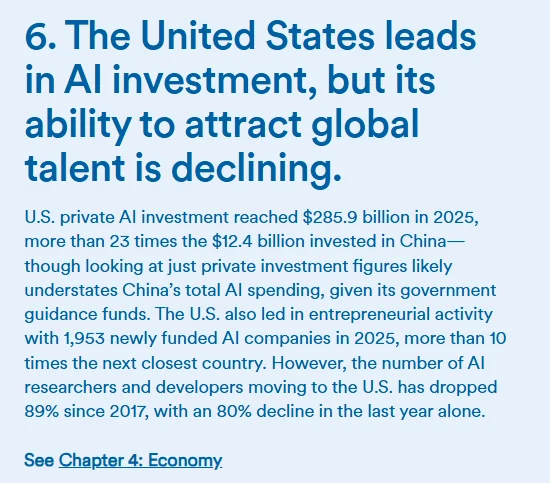
Our read of these numbers: the investment gap is huge, but the capability gap is small. That combination is good news for users, because it means a lower-cost challenger can be competitive on quality for many everyday tasks. It also means rankings shift within months, so any "top 10" list without a date should be treated with caution.
What you get: plans and prices from the top generative AI companies
Brand recognition is a poor guide to value. Here is what the consumer plans of the top generative AI companies cost, using the prices on each vendor's own pricing page as of 2026-10-25. Indonesian rupiah prices are shown where the vendor shows them for Indonesia.
| Product (company) | Free tier | Entry paid plan | Higher plans | Source |
|---|---|---|---|---|
| ChatGPT (OpenAI) | IDR 0 | Go, IDR 75,000/month (may include ads) | Plus IDR 349,000/month; Pro from IDR 1,889,000/month | chatgpt.com/pricing |
| Gemini (Google) | Rp 0 | Google AI Plus, Rp 75.000/month | AI Pro Rp 309.000/month; AI Ultra from Rp 1.579.000/month | gemini.google/subscriptions |
| Claude (Anthropic) | $0 | Pro, $20/month ($17/month billed $200 yearly) | Max from $100/month | claude.com/pricing |
| Vibe, formerly Le Chat (Mistral AI) | Free plan (no price shown) | Pro, $14.99/month excl. taxes | Team $24.99/user/month | mistral.ai/pricing |
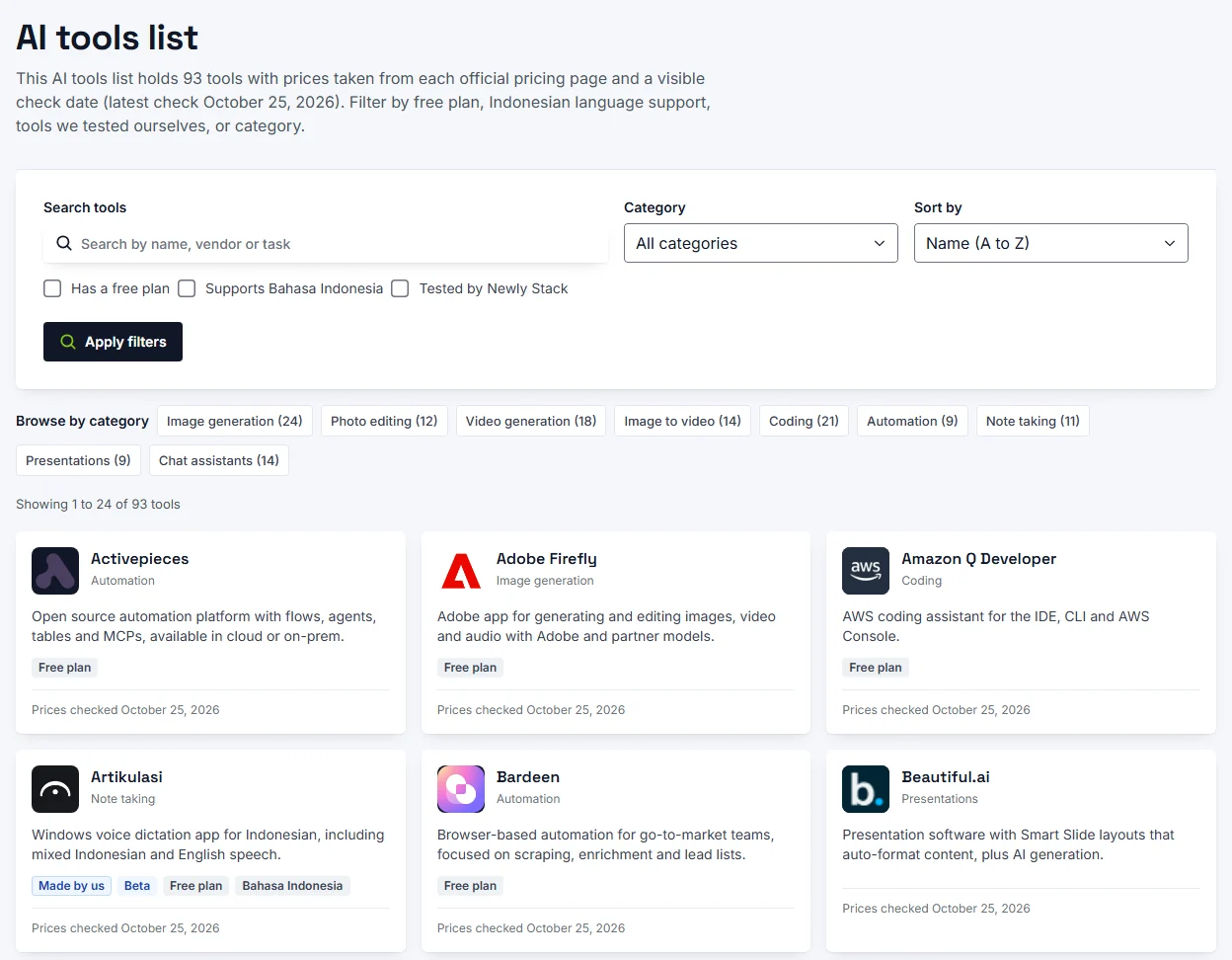
For Meta AI, Copilot, Perplexity, Grok, Kimi and others, prices change often and some are shown only after login, so we keep them on each product's page in our AI tools directory with the date we last checked.
A few things stand out. ChatGPT and Gemini now both have a low-cost tier at the same rupiah price point, which matters a lot for Indonesian users who found the old $20 plans expensive. Claude's prices are still shown in US dollars. And the free tiers are generous enough that many people never need to pay. Our list of free AI tools covers the best options that cost nothing, and our deals page tracks verified discounts when they appear.
AI for companies: how to pick a vendor
If you are choosing AI for a company rather than for yourself, the question changes from "which chatbot is smartest?" to "which vendor can we live with for the next two years?" Here is the checklist we would use.
Start from the job, not the logo
The best model for writing code is not always the best for summarising Indonesian customer chats. Browse by task first: AI for coding, AI for image generation and AI for video generation each compare the tools that fit that job. Then shortlist two or three vendors and test them on your own real prompts, not on demo examples.
Check language support in writing
If your team or customers work in Bahasa Indonesia, look for an official language list. OpenAI, Google, Anthropic and Microsoft publish one that names Indonesian. Several other artificial intelligence companies do not, which does not mean the model is bad at Indonesian, only that the vendor has not committed to it. That is exactly the gap our Bahasa Indonesia benchmark is designed to fill, by scoring models on the same Indonesian test set.
Plan for switching
Prices and rankings move quickly, as the Stanford data above shows. Keep your prompts, documents and workflows in a format you control. Open-weight models from Qwen or DeepSeek give you a fallback you can host yourself, at the cost of running your own infrastructure. If you are weighing whether to build your own product on top of these models, our guide on starting a startup covers the early decisions.
How we keep this list of AI companies honest
Lists of artificial intelligence companies go stale fast: a model that led in spring can trail by autumn, and plan prices change several times a year. No page can track all AI companies, so we track fewer and keep them current. Here is how we handle it at Newly Stack:
- Every fact has a date and a source. Prices and language support above link to the vendor's own page, checked on 2026-10-25. Our directory flags any fact older than 90 days as "needs re-check" and drops it from comparisons.
- We separate what vendors claim from what we measure. A help page saying "Indonesian supported" is a vendor claim. Model scores on our AI model leaderboard and in our benchmarks come from tests we run with a published method.
- We say when we have not tested something. This guide is a researched overview, not a hands-on review of every product. Where we have no official source, we write "not confirmed" instead of guessing.
If you just want a short answer, here it is. For most people, the useful artificial intelligence companies are the ones whose product fits the task, supports your language and has a plan you can afford. Browse the best AI apps, see ChatGPT alternatives if you want to look beyond OpenAI, or follow new products each week on our launches page.
Frequently asked questions
What are the biggest artificial intelligence companies in 2026?
By model capability and reach, the leading group is OpenAI (ChatGPT), Google (Gemini), Anthropic (Claude), Meta, xAI (Grok) and Microsoft (Copilot). On the hardware side, NVIDIA, Google (TPUs) and Amazon Web Services (Trainium) supply much of the compute. Chinese labs such as DeepSeek, Alibaba's Qwen team and Moonshot AI (Kimi) are close behind on capability.
Which AI companies offer a free plan?
ChatGPT, Gemini, Claude, Microsoft Copilot, Perplexity, DeepSeek, Meta AI, Mistral and Qwen Chat all list a free tier in our directory as of 2026-10-25. Free tiers come with usage limits that change often, so check the vendor's pricing page before you rely on one.
Do AI chatbots from these companies work in Bahasa Indonesia?
OpenAI, Google, Anthropic and Microsoft all list Indonesian as a supported language in their official help pages, and Alibaba lists Indonesian among the 119 languages its Qwen3 models support. For Mistral, xAI, Meta and DeepSeek chat we could not find an official, publicly reachable language list that names Indonesian. Our Bahasa Indonesia benchmark scores how well each model actually handles Indonesian tasks.
Are Chinese AI companies really competitive with US ones?
On benchmarks, yes. Stanford HAI's 2026 AI Index says US and Chinese models have traded the lead since early 2025, and that as of March 2026 the top US model led by just 2.7%. The bigger gaps are in investment and data centers, where the US is far ahead.
How should a company choose an AI vendor?
Start from the task, not the brand. Test two or three vendors on your own real prompts, check data and privacy terms, compare total cost at your expected volume, and confirm the language you work in is officially supported. Keep your prompts and data portable so you can switch if prices or quality change.
Which companies make AI chips?
NVIDIA is the default choice for training and running large models, with its Rubin, Blackwell and Hopper platforms. Cloud providers also build their own: Google designs Tensor Processing Units (TPUs) and rents them through Google Cloud, and Amazon Web Services sells Trainium, which it calls a purpose-built AI chip. Anthropic says it runs Claude on all three families.
How much money is going into AI companies?
Stanford HAI's 2026 AI Index reports that US private AI investment reached $285.9 billion in 2025, more than 23 times the $12.4 billion invested in China. It also counts 1,953 newly funded AI companies in the US in 2025. Stanford notes that private figures likely understate China's total AI spending.
Is Mistral Le Chat still available?
Mistral renamed its assistant from Le Chat to Vibe; the product page says "Le Chat is now Vibe." On 2026-10-25 Mistral's pricing page listed a free plan, Pro at $14.99 per month excluding taxes and Team at $24.99 per user per month.
Sources
Pages we read for this article, with the date we accessed each one.
- Stanford HAI, The 2026 AI Index Reportaccessed October 25, 2026
- Wikipedia, List of artificial intelligence companiesaccessed October 25, 2026
- ChatGPT Pricing (OpenAI)accessed October 25, 2026
- Google AI subscriptions (Gemini), Indonesia pricingaccessed October 25, 2026
- Claude pricing (Anthropic)accessed October 25, 2026
- Mistral AI pricingaccessed October 25, 2026
- OpenAI Help Center, How to change your language setting in ChatGPTaccessed October 25, 2026
- Google Gemini Apps Help, supported languagesaccessed October 25, 2026
- Claude Help Center, How to use Claude in your preferred languageaccessed October 25, 2026
- Qwen3: Think Deeper, Act Faster (Qwen team blog)accessed October 25, 2026
- DeepSeek on Hugging Faceaccessed October 25, 2026
- Microsoft Support, Supported languages for Microsoft Copilotaccessed October 25, 2026
- Google Cloud TPUaccessed October 25, 2026
- NVIDIA Data Centeraccessed October 25, 2026
- AWS Trainiumaccessed October 25, 2026
- Anthropic expands partnership with Google and Broadcom for multiple gigawatts of next-generation compute (Anthropic, 6 April 2026)accessed October 30, 2026
Related articles
Frontier AI: What It Means, Who Builds It, and How to Judge It
Frontier AI explained with dated facts: official definitions, the compute thresholds regulators use, flagship models and API prices, and how to test them.
How to Use AI: A Practical Beginner's Guide (2026)
Learn how to use AI step by step: pick one assistant, write clear prompts, check every answer, and set up your own AI helper without training a model.
AI Data Center: What It Is, How It Works and Why It Matters
An AI data center trains and runs AI models on GPUs and other accelerators. See how it differs from a regular data center, its power use and who builds them.